
A tiny ruleset with a surprisingly deep endgame
Dots and Boxes begins with dots and empty edges. On each turn you draw one horizontal or vertical line between adjacent dots. Complete the fourth side of a box and you claim it, then move again. When no edges remain, the player with more boxes wins.
The rules take seconds to learn, but the game changes character as the board fills. Early play is about safe edges. Late play is about chains of boxes that can be handed to one player all at once.
The third side is the basic unit of risk
A box with two sides is often still safe. Drawing its third side usually creates an immediate capture for the opponent unless the move is part of a larger tactic. Much of the opening is therefore about finding edges that do not turn a box into a gift.
Recognising safe moves is the first strategic jump. The goal is not to score as quickly as possible, but to control who is eventually forced to open a dangerous region.
Capturing keeps the turn
When you complete a box, you move again. This turns a local opportunity into a sequence. If several boxes are lined up with three sides prepared, one entry can trigger a chain of captures.
A single edge can also complete two boxes at once. At those junctions, the move is worth more than a simple point.
Chains dominate the endgame
Once safe edges disappear, someone must open a chain. The opponent may then collect several boxes in succession. Advanced strategy is largely about controlling the size and timing of those handouts.
Not every box has equal strategic value. An isolated box may be cheap; one edge that opens a six-box corridor can decide the game.
Four sizes, four rhythms
Blupoli offers 3×3, 4×4, 5×5 and 6×6 box boards. On smaller boards each edge carries more weight and the endgame arrives quickly. Larger boards contain more independent regions and can support several potential chains at once.
Size changes duration and planning scope, but it does not replace CPU difficulty.
A CPU that does more than play randomly
Easy mixes random choices with occasional captures. Normal prioritises captures and safe edges. Hard and Expert use alpha-beta search, evaluate chains and risk, and progressively increase search depth, time and breadth.
Higher difficulty does not receive different rules or hidden information. It plays the same board but evaluates consequences more effectively.
Extra turns inside the search tree
Dots and Boxes has a detail that complicates AI: after a capture, the same player moves again. A search tree that blindly alternated player after every edge would misunderstand chains completely.
Engine tests explicitly verify that captures preserve the turn and that advanced search considers tactical handout alternatives. It is a small rule with a large effect on behaviour.
Playing the opening
Look for edges that do not create a third side. If a free capture exists, it is usually worth taking because it keeps your turn. Before closing a box, however, inspect what edge remains afterwards: a capture can sometimes open a larger chain for the opponent.
Against easier levels, avoiding obvious gifts is enough to play sensibly. Against a stronger CPU you need to think in regions rather than individual boxes.
What to watch in the middle game
Count boxes with two and three sides and notice how they connect. A cluster of two-sided boxes can quickly become a chain. Try to preserve at least one safe edge while forcing the opponent to consume alternatives elsewhere.
The goal is to reach the no-safe-moves phase in a favourable role: ideally the other player is forced to open the most expensive structure first.
Winning is not the same as capturing early
This is the idea that separates beginner intuition from strategic play. One box now can cost four later. Declining a capture or accepting a small handout can be correct if it changes who controls the final long chain.
Advanced CPU levels try to evaluate exactly that horizon rather than only the immediate score.
Undoing rounds and persistent games
The interface uses “Undo round” because one turn can contain several consecutive captures before control passes to the CPU. State is persisted so a larger game can be resumed without losing that sequence.
When the board ends, the result enters Blupoli's shared completion system with win, loss or draw, score, duration and move count. Competitive wins count as completed activity; losses and draws are not treated as solved puzzles.
A useful contrast with unique-solution puzzles
Most logic games in Blupoli have one correct final state that can be proven. Dots and Boxes is different because the problem changes in response to an opponent. You are evaluating alternatives rather than discovering a single hidden configuration.
That is why it belongs to the strategy-against-CPU family and adds a different kind of reasoning to the platform: multi-turn planning, territorial control and anticipation.
What exactly is a safe edge?
An edge is safe when drawing it does not create a three-sided box that the opponent can immediately close. Early in a game there are usually many; as the board fills, they disappear. The basic skill is recognising them and consuming them in an order that does not leave you as the first player forced to give away a chain.
The definition looks local, but one edge may belong to two boxes. To decide whether it is safe, inspect both. A line that causes no problem on the left can create the third side on the right. On larger boards this double ownership causes many tactical mistakes.
There are also positions where an unsafe edge is strategically correct. If every alternative opens a worse chain, giving away one small box can preserve control elsewhere. “Safe” describes immediate risk, not total move value.
Chains as strategic objects
When a sequence of boxes is arranged so that closing one makes the next capture available, a chain appears. Once opened, one player can run through it because every capture preserves the turn. The score can therefore change dramatically after several quiet turns with no points.
It helps to recognise chains before they are fully formed. A narrow region containing several two-sided boxes can evolve into a long structure. The edges connecting that region to the rest of the board often determine who will eventually be forced to open it.
Near the end, counting future boxes by chain is often more informative than looking at the current score. A player can be behind while still controlling enough chained territory to win.
The idea of a handout
A handout occurs when you deliberately play an edge that lets the opponent collect one or more boxes. At first this sounds automatically bad, but Dots and Boxes contains positions where giving away a small amount prevents surrendering a much larger chain. Advanced play compares future costs rather than the immediate point.
Higher CPU levels try to evaluate these alternatives during search. The engine therefore preserves tactical handout options instead of pruning them as obvious mistakes. A search that only valued instant captures could play sensible openings and still collapse in structured endgames.
This is one of the ideas that turns an extremely simple ruleset into a serious planning problem.
Why the extra-turn rule complicates AI
Many turn-based games alternate player after every action. Dots and Boxes does not. If an edge completes a box, the same player acts again and may continue capturing for several moves. A search tree must model that exactly; otherwise it evaluates chains as though players were sharing them and produces nonsense decisions.
Tests protect this transition because it is easy to break during refactoring. The next player depends on the result of the applied move. Capture something and the player remains the same; capture nothing and control switches.
This small condition is a good example of why correct AI starts with correct rules rather than deeper search.
What the CPU evaluates when it cannot search to the end
On a large board it is too expensive to explore every line all the way to the final score during most of the game. Search therefore needs an intermediate evaluation. Score matters, but so do third-side risk, the number of safe moves and the chain structure likely to remain.
Hard and Expert increase depth, time and breadth budgets, and late positions with fewer free edges can be searched much closer to the actual end. Alpha-beta pruning avoids exploring branches that can no longer improve on a known choice.
This does not make the CPU omniscient. It makes stronger levels consider longer consequences and commit fewer simple tactical errors.
Capture order can matter
When several boxes are available, the order of capture is not always irrelevant. One edge may close two boxes, another may preserve a strategic exit and another may commit you to consuming a chain. Because every capture keeps the turn, order changes the final state that will be handed back to the opponent.
In simple situations the right move is to collect every free box. In more structured endgames, the geometry of a region can make a particular stopping pattern valuable. This is why strong play looks beyond the highlighted box that can be taken right now.
The interface keeps these sequences clear, while “Undo round” groups actions in a way that matches the actual turn structure.
Learning through the four CPU levels
Easy is useful for learning the rules and seeing captures without every third-side mistake being punished. Normal already prioritises captures and safe edges, making giveaways more visible. Hard asks you to anticipate chains. Expert spends more search effort on tactical and late-game positions.
Moving up a level is most useful when you can explain why a chain was lost rather than simply feeling that the CPU is stronger. Look back at the moment safe edges disappeared and ask which player became responsible for opening the first long structure.
That turns defeats into strategic information and makes difficulty a progression in board reading rather than just a tougher opponent label.
What Dots and Boxes adds to Blupoli
Most games in the platform are puzzles with one correct configuration. Dots and Boxes introduces adversarial logic: the best move depends on what the opponent can do next. There is no single pre-existing “solution board”. There is a tree of decisions and responses.
That difference also forces progress and statistics to be more precise. Finishing a competitive match is not automatically equivalent to solving a puzzle. The result must preserve win, loss or draw, and only a win should count as competitive success for streak semantics.
This model is useful beyond one game because it pushes the platform to support genuinely different modes instead of assuming every experience ends the same way.
An example of why a “free” box can be expensive
Suppose you can close one box now, but the required edge exposes the third side of a four-box chain. Because you score, you move again; you may take the first box and then discover there is no safe exit, eventually handing the entire chain to the CPU. A non-scoring move elsewhere might keep that chain closed and force the opponent to open it later.
The example shows why immediate score is not enough to evaluate a move. You need to consider the structure that remains after your whole extra-turn sequence ends.
Controlling regions on larger boards
On 5×5 and 6×6 boards, several regions can evolve almost independently during the opening. It helps to identify which areas still contain safe edges and which are close to becoming chains. Consuming every safe edge in one region too early can force you to open it before necessary.
Spreading moves across regions preserves options. Much of the planning comes from keeping one future safe exit available while the opponent gradually loses theirs.
Learning from a loss against Expert
The final score often hides the decisive moment. Find the first long chain that changed hands. Who drew the third side that opened it? Was another safe edge available? Did an earlier capture force continuation into a bad state? These questions reconstruct the game more usefully than comparing points alone.
Because moves and results are tracked, a match can be understood as a sequence of decisions rather than one final number.
Why draws matter too
A draw is a real competitive outcome even if it does not count as success for a winning streak. Distinguishing it from a loss produces more accurate statistics and prevents the platform from collapsing every experience into solved versus unsolved.
This precision matters beyond one game. Future CPU games may need their own result semantics, and Dots and Boxes provides a useful test case for progress systems that support more than one kind of finish.
The endgame when only chains remain
Late in a game, the board can split into components where every available edge necessarily opens a capture. At that point safe moves no longer exist in the opening sense. The question becomes who controls the order of openings and how expensive each component is.
Counting chain lengths before entering them lets you compare losses. If something must be handed over, you may be able to surrender a short chain while preserving a longer one for a later sequence. The correct decision depends on score, the number of remaining components and which player will keep the turn through each capture.
This is why a match can become strategically decided before the last edge is drawn even though many boxes remain unclaimed.
Playing around double captures
An edge shared by two boxes can complete both at once. These tactical points double the immediate value of a connection and preserve the turn with a larger swing. Before offering a region containing two nearly complete boxes, check whether one edge will allow the opponent to collect both.
Conversely, preparing a double capture can be useful when it changes who is forced to open another region. The value lies not only in two points but in the turn sequence that follows.
Advanced CPU search must model multi-box captures correctly; treating them as separate turns would distort the evaluation completely.
Planning with the actual score
Chains matter because they produce points, and strategy must always return to the scoreboard. When comfortably ahead, simplifying the position and accepting a small handout may be correct. When behind, preserving a long structure capable of producing a large swing may be necessary.
The same geometry can therefore demand different decisions depending on the score. Dots and Boxes is not merely a pattern-recognition puzzle; it is an adversarial game where context changes the value of every pattern.
Three questions before every edge on Hard and Expert
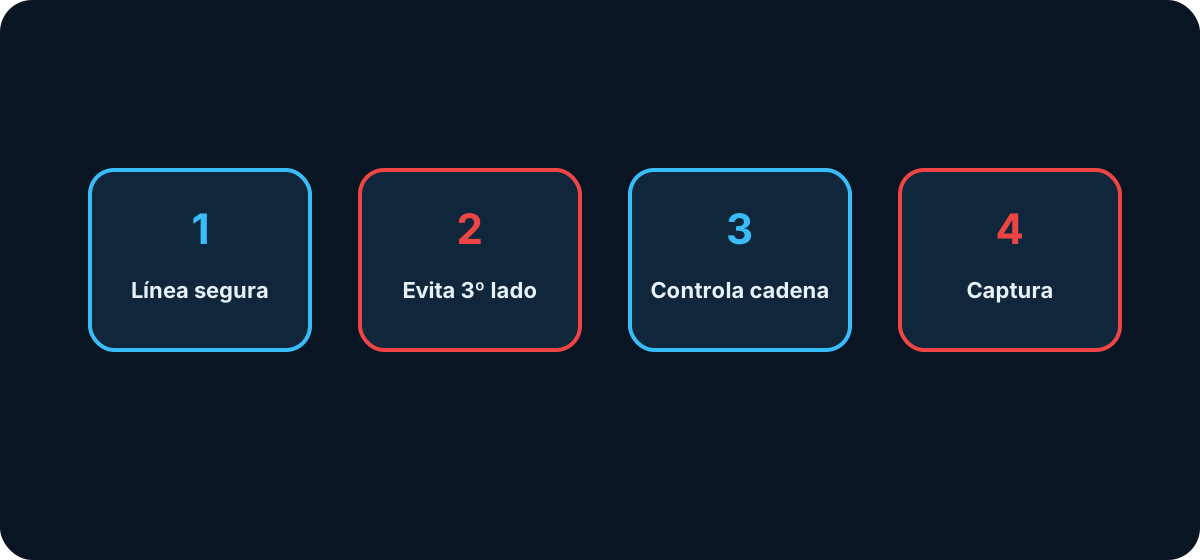
Ask: does this edge create a third side? If so, how many boxes could the opponent chain from it? If not, am I consuming the final safe move in this region? This short protocol prevents many tactical losses without calculating the whole game tree.
With experience the questions become visual. Dangerous regions stand out because of their density of two- and three-sided boxes, and future chains become visible long before the endgame.
Reading the board by danger level
A practical way to analyse a position is to classify boxes by the number of drawn sides. Zero- and one-sided boxes are usually quiet; two-sided boxes deserve attention because they can grow into chains; three-sided boxes are immediate captures for whoever receives the turn.
This classification simplifies larger boards. You do not need to calculate every branch. Identify where two-sided boxes cluster and which free edges connect those regions. That is where the strategic endgame is forming.
The method does not replace deep CPU search, but it gives human players a clear heuristic for planning several turns ahead without becoming lost in individual edges.
Choosing board size and CPU level for learning
A 3×3 or 4×4 board against Normal is a good laboratory for seeing third-side risk and chains without tracking too many regions. Once those structures become obvious, moving to 5×5 or 6×6 adds spatial planning. Raising CPU strength afterwards forces more accurate consequence evaluation.
Separating size and opponent level avoids a misleading conclusion: losing on a huge board against Expert does not tell you which concept is missing. Change one variable at a time to identify whether the problem is chain reading, region control or tactical depth.
Difficulty then becomes a learning tool rather than simply a way to make the game harsher.
Why tempo matters even without a clock
Dots and Boxes has no chess clock, yet it contains a useful idea of tempo: who is forced to make the next damaging move. A safe edge can function as a waiting move, preserving a dangerous region while transferring responsibility elsewhere. Once those waiting moves are exhausted, the player to move may have no choice but to open a chain.
This explains why apparently neutral edges can have strategic value. They do not score and may not change a nearby box dramatically, but they change the order in which commitments must be made. On larger boards, keeping track of several regions means thinking about which supply of safe moves will run out first.
Strong CPU play needs to value this timing indirectly through search, while a human can often reason about it by simply counting safe alternatives in each region.
Reviewing an entire round rather than one edge
Because captures grant extra turns, a meaningful decision unit is often a round of consecutive moves rather than one isolated edge. When reviewing a mistake, ask where the sequence began and what state was handed to the opponent after all forced captures ended.
This is also why the interface groups Undo around rounds. Rewinding only the last capture could leave you in the middle of a sequence that was strategically one decision. Thinking in rounds makes both the UI and the game tree easier to understand.
Once this perspective becomes natural, long chains stop looking like a burst of unrelated points and start looking like one consequence of the edge that opened them.
Keep exploring
The Dots and Boxes: the real game begins when safe edges run out page links to nearby games that use similar skills in a different form. Moving between them is a useful way to notice which techniques transfer and which belong specifically to this rule set.
The goal is not to memorise a trick. It is to learn how local constraints accumulate until a move becomes inevitable. That is the common language behind many of the logic games in Blupoli Puzzles.