

A matrix solved by removing possibilities
Logic Matrix begins with a very simple model: every row is a category and every column is a position. Each symbol from a category must appear exactly once. What you see at the start is not a field of empty cells waiting for answers, but a collection of candidates. Solving means removing what can no longer occupy a position until only one option remains.
That changes the rhythm of the puzzle. You are rarely looking for a complete answer in one leap. A clue may only rule out two columns, yet that reduction can be exactly what another clue needs to become decisive. The board behaves like a network in which a small certainty propagates.
Two clue families, two ways of thinking
Vertical clues connect two symbols directly. They can say that the symbols share a column or that they never do. These clues are compact and powerful because they link categories without giving an absolute position.
Horizontal clues describe spatial relationships: adjacency, non-adjacency, left-to-right order, being between two symbols, or not occupying that middle relation. Near the edges those rules become stronger. A symbol that must sit between two others cannot occupy the first or last column. Small observations like that often open the board.
How to start without reading everything at once
A useful first pass is to look for relations with very few ways to be satisfied. Same-column pairs, three-symbol clues and adjacency near an edge are natural candidates. Then scan rows and columns for symbols that have been reduced to one possible position.
The interface is built around that method. Select a cell, inspect its candidates at a readable size and remove possibilities. A tile revealed at the beginning is a fixed fact, not an extra clue. Easier levels use more of these givens; Hard and Expert remove them and make clue combination carry the puzzle.
Double-clicking and the difference between excluding and confirming
A candidate matrix can become tedious if every confirmation requires manually disabling every alternative. Logic Matrix keeps the explicit elimination workflow, but also lets you confirm the chosen option with a double click. Both paths produce the same logical state: one remaining candidate in the cell.
This matters on larger boards. You can keep every exclusion visible while a deduction is still developing, then lock a position quickly once it is proven. On touch devices the layout preserves generous targets; on desktop it uses the extra room to keep clues and board readable.
Four sizes that genuinely change the logical load
Logic Matrix offers 4×4, 5×5, 6×6 and 7×7 boards. This is not simply more surface area. Every added row brings more symbols, more positions and more potential relationships. A 4×4 board can often be held almost entirely in working memory, while a 7×7 board rewards solving by regions and revisiting clues after every confirmation.
Difficulty is independent from size. A large board can remain approachable when it contains more direct information, while a small one can demand several linked deductions. That separation lets you choose between visual breadth and logical density.
What real difficulty means here
The engine tests do not merely check that Easy, Medium, Hard and Expert have different labels. For every size the generator is deterministic, every clue is verified against the hidden solution and a logical solver must finish without guessing. A second solver then counts solutions and requires exactly one.
The progression is structural as well. Easy exposes more starting tiles, Medium exposes fewer, and Hard and Expert expose none. Higher bands rely less on direct clues and increase the average structural complexity of the clue mix. Difficulty is meant to come from reasoning, not arbitrary opacity.
Why uniqueness matters
Ambiguity is particularly unpleasant in an elimination puzzle. A player can reach a state where two candidates appear equally valid and assume a subtle deduction has been missed. If the puzzle actually has two solutions, the failure belongs to the puzzle rather than the solver.
Logic Matrix therefore accepts only generated boards for which the solver proves a unique solution. Counting stops at two: finding a second valid completion is enough to reject that candidate. That guarantee gives the player a useful contract—guessing is unnecessary.
A hint should not replace the solve
When you ask for help, the engine tries to identify an impossible candidate or restore a correct candidate that was removed by mistake. It does not simply fill an entire row. The purpose is to reveal the next useful step while leaving the rest of the reasoning intact.
Undo and Redo serve the same philosophy. A touch mistake or an exploratory move should not destroy a good session. You can inspect a consequence, go back and continue reading the matrix.
Logic Matrix versus Zebra Grid
The two games share a candidate-grid foundation, but they are not reskins. Logic Matrix deliberately uses a small set of graphical horizontal and vertical clues. Zebra Grid works at much larger sizes and uses a broader visible clue language. Logic Matrix is about extracting a surprising amount from relatively few clues.
The scale follows that distinction. Logic Matrix stops at 7×7 and remains compact. Zebra Grid reaches 12×12 and needs a desktop arrangement where clues can occupy their own column without shrinking the board into irrelevance.
A practical routine when you get stuck
Return to a fixed scan. Check same-column and adjacency clues first. Look for symbols that have lost edge positions. Then inspect every row: does any symbol appear as a candidate in only one cell? Finally revisit every clue involving a tile you just confirmed.
This prevents the feeling of staring at the whole board without an entry point. Logic Matrix rewards consistency. Each exclusion can look tiny while quietly shrinking several other clue domains at once.
Keeping hypotheses open without guessing
The central skill is not symbol memorisation. It is becoming comfortable with partial information. For much of a game you may know that an item can occupy two or three columns, and you do not need to choose yet. Leaving that hypothesis open until another relationship closes it is part of the design.
The candidate system makes uncertainty visible rather than forcing the player to hold it all mentally. You can inspect it, revise it and reduce it step by step. That visibility is what turns a dense relation puzzle into a sequence of understandable decisions.
Read a clue as a constraint, not as a sentence
One of the most useful improvements in Logic Matrix comes from changing the question you ask when looking at a clue. Instead of “what exact answer does this clue give me?”, ask “which positions has this clue just made impossible?”. The distinction sounds small, but it changes the solving process. An adjacency clue, for example, does not immediately identify one pair of columns. It reduces both symbols to positions from which a compatible neighbour can still exist. If one symbol is already restricted to an edge, the relation suddenly becomes much stronger. A between clue behaves similarly: the middle item loses both edges automatically and the outer items must sit on opposite sides.
This way of thinking is especially important for negative clues. “A is not adjacent to B” appears weaker than “A is adjacent to B” because many configurations satisfy it. But once either symbol has lost several positions, the negative relation may cut exactly the remaining options that matter. On higher difficulties, a large part of the progress comes from revisiting a clue that looked weak earlier. The clue has not changed; the candidate domains on which it operates have.
That is why the board keeps candidates visible. The puzzle is not asking you to memorise every possible combination. It gives you a way to see each domain shrink over time. A relation is valuable whenever it reduces those domains, even when it does not produce a final placement immediately.
The “once per row” rule as a propagation engine
Every symbol appears exactly once in its row. The rule is obvious, yet it is the bridge between local clues and global consequences. Suppose one symbol is still available in three positions. One clue removes the first and another relation removes the second. The third is now fixed even though no clue ever said “the symbol is here”. Once fixed, the same symbol disappears from all other cells in that row and may tighten several other relations.
The inverse form matters just as much. A cell may still show several candidates, but one of those candidates might not appear anywhere else in the row. That makes the position forced by uniqueness even though the cell does not look solved at first glance. This is easy to miss if you only count candidates per cell. Periodic scans by symbol, not only by position, are valuable.
On 6×6 and 7×7 boards this habit becomes essential. There are too many candidate marks to remember reliably. A systematic row scan turns the matrix into a counting tool and prevents a valid deduction from hiding behind visual density.
Why edge relations are special
Edge columns break symmetry. If a symbol at the first column must be adjacent to another item, that partner can only be in column two. A between relation can never put its middle element on an edge. Left-to-right clues also change strength depending on how much space remains on each side. These properties make edges a constant source of early deductions.
A useful routine is to revisit every clue involving edge candidates after each confirmation. If a symbol loses column two, for example, an adjacency clue may remove column one from its partner immediately. That exclusion can trigger a uniqueness rule elsewhere and create a chain across several categories.
Relation puzzles often make the centre look richer because it contains more combinations. Paradoxically, edges are usually more informative because they have fewer degrees of freedom. Logic Matrix uses that geometry to create depth without requiring a huge visible clue set.
What “no guessing” means in practice
No guessing does not mean that every move is obvious. It means that a deductive sequence exists without assuming a candidate is correct merely to see whether it produces a contradiction later. The logical solver used during generation follows exactly that standard: it propagates constraints until the board is complete. If it needs to branch on a hypothesis, the candidate puzzle does not meet the intended logical contract.
For a human solver, the same chain may be difficult to spot. An Expert board can require several clue rereads after a small exclusion and a uniqueness step that only becomes visible after three relationships interact. The distinction between difficulty and randomness still matters. When stuck, the recommendation is not “try something”. It is to identify which candidate domain changed most recently and which clues depend on it.
The hint system follows the same philosophy. Useful help should move you toward the next real deduction rather than arbitrarily filling a region. Pointing out one impossible candidate preserves the logical route and makes the remaining work understandable.
Building structural difficulty
A difficulty model based only on clue count can be misleading. Ten direct clues may create an easier board than twelve complex relations, and two boards with equal counts may have completely different deduction chains. Logic Matrix therefore keeps statistics about clue families, average complexity and the proportion of direct relations.
Easy includes more revealed tiles and clues that reduce the board quickly. Medium removes some of that support. Hard and Expert remove starting givens entirely. Expert also lowers the ratio of especially direct clue types and increases the weight of relations that need more context. Tests compare a structural difficulty score and require it to rise from band to band for every size.
This is not presented as a perfect psychological measurement of human effort. A solver and a person do not experience clues in the same way. The practical goal is to prevent decorative difficulty labels and to catch regressions where a generator change accidentally makes Expert as direct as Easy.
Common candidate-management mistakes
The most common mistake is eliminating too early. A negative clue may reject one pairing without rejecting an entire position while the partner symbol can still move. Before removing a candidate, try to state the deduction precisely: “if this symbol were here, this relation could no longer be satisfied.” If you cannot finish that sentence, the conclusion may be premature.
A second mistake is confirming a cell after considering only one clue. Logic Matrix is deliberately built from intersecting relationships; a possibility can satisfy one clue and violate another. The third common mistake is forgetting to propagate a confirmed tile. Solving one cell is not the end of a step. You must remove that symbol from the rest of its row and revisit every clue that contains it.
Undo is a natural part of interaction because the interface supports exploration, but the goal is still to make each important move explainable. The best measure of progress is not the number of closed cells. It is the coherent reduction of the overall possibility space.
A full game as repeated information cycles
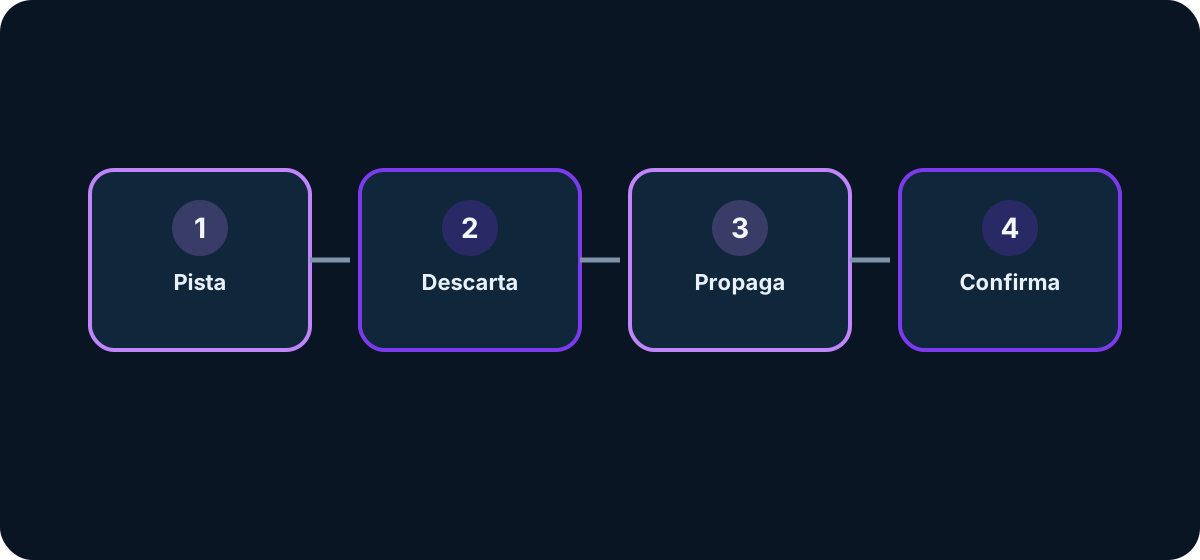
One way to understand a session is as a set of cycles. First read the strongest clues. Then make exclusions. Those exclusions create one or two uniqueness placements. Those placements change other clues. Then read again. Every cycle reduces the number of possible states and strengthens relations that previously carried little information.
On a 4×4 board those cycles are short, and several cells may resolve in one pass. On 7×7 there can be quiet regions that remain dormant until a distant confirmation activates them. Knowing this prevents forced moves when one area appears frozen. Work elsewhere and return later with a different candidate landscape.
That rhythm is one reason Logic Matrix works well as a deduction puzzle. It does not depend on a single secret technique. It asks for discipline when recording uncertainty, patience not to close hypotheses too early and attention to clues whose meaning changes as the board becomes smaller.
A mental example: combining three clues without trial
Imagine an animal row where the fox can only occupy columns two, three or four. One clue says it is adjacent to a boat from another category. Another says the boat is left of a star. A vertical relation then prevents the star from sharing a column with a fruit already fixed in column four. No single clue places the fox. Together they remove complete sequences of positions: if the boat were in four, the star would need space to its right; if it were in three, the star could not use four; if the star is pushed toward five, fox adjacency tightens in response.
This is representative of the game because solutions emerge from intersections rather than one magical clue. The practical goal is to keep every candidate domain current so that the next relation operates on already reduced information.
If a three-clue chain feels too large to hold mentally, break it into small consequences and record each exclusion before continuing. The board exists precisely to externalise that memory.
Choosing between double click and explicit elimination
Double-click confirmation is convenient once a position is proven, but it does not replace the value of visible exclusions. During a complex deduction, removing candidates one by one can reveal a uniqueness pattern elsewhere. When a relation fixes a position outright, direct confirmation avoids a mechanical sequence of taps.
The strongest workflow treats the board as a notebook: preserve partial information when it adds context and close quickly what no longer needs discussion. That flexibility reduces friction without hiding the logical process.
On desktop, double click speeds up confirmations; on touch devices, comfortable cell and candidate targets remain the priority. Interaction should never become an extra source of difficulty.
What to practise if Expert feels opaque
Do not jump straight to longer chains. Practise three habits separately: scanning rows for a symbol with one remaining position, revisiting edge-sensitive relations after every placement, and rereading negative clues only when one of their domains has changed. These habits create most of the stepping stones needed for Expert boards.
It also helps to solve the same size at several difficulty levels. Because the rules stay constant, the difference becomes visible in the amount of direct support and the density of structural clues. That makes difficulty easier to understand than moving to a larger board at the same time.
When a solve goes wrong, use Undo to locate the first unsupported exclusion rather than merely correcting the final conflict. Finding that first unjustified move is more useful for improving than finishing the board by patching later consequences.
Using solved cells as new clues
A confirmed cell is more than the end of one deduction. It becomes a new fact that reshapes every relation involving that symbol and every remaining position in its row. Strong solvers treat confirmation as the start of a propagation phase rather than a moment to move elsewhere immediately.
After fixing a tile, remove the symbol from the rest of its row, inspect clues touching it, check whether any neighbouring or ordering relation has become edge-sensitive, and then scan for newly unique candidates. This short ritual prevents solved information from sitting unused.
On Expert boards, many apparent dead ends are simply places where a previous confirmation has not yet been propagated through all dependent clues. The puzzle often opens again as soon as that bookkeeping is completed.
Practising clue reading without confusing it with board size
To improve specifically at Logic Matrix, keep board size fixed for several games and change only difficulty. That makes it easier to notice what happens as starting givens disappear and direct relationships become less common. Then reverse the experiment: keep a familiar difficulty and move from 4×4 through 7×7. This separates the skill of chaining clues from the skill of managing more candidate domains.
It also helps to review a completed game and identify the first moment when a negative clue became useful. That point usually reveals how accumulated information transforms an apparently weak relation. After several sessions, you begin to recognise these changes in strength earlier and spend less time rescanning clues that are not ready yet.
Progress is not about memorising solutions. It is about recognising which constraints have become valuable in the current state.
Where to go next
If this style of deduction works for you, continue with the related games linked from the Logic Matrix: extracting certainty from a few clues page. Blupoli groups games by the kind of reasoning they ask for, so moving from one puzzle to another is a way to compare techniques rather than just change the decoration.
The important point is not to solve quickly. It is to understand why a candidate, line or position has become impossible. Once that habit is established, harder boards stop looking like larger walls of information and start behaving like chains of small, checkable decisions.