
Two symbols and three rules that change everything
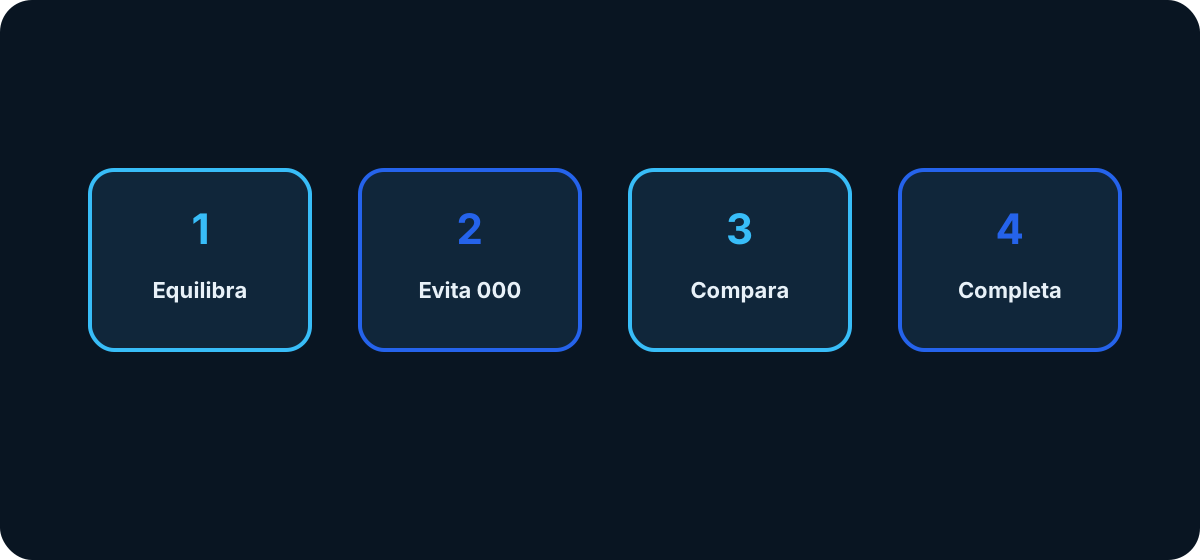
Takuzu uses only 0 and 1, but it is not random binary filling. Every row and column must contain equal numbers of both values, three identical symbols may never appear consecutively, and no two completed rows or columns may be identical.
The rules reinforce one another. A cell ambiguous under the balance rule can become forced to avoid a triple; an almost complete line can be decided because matching an existing line would be illegal.
The balance rule
On an 8×8 board every row and column finishes with four zeros and four ones. Once a line reaches four zeros, every remaining gap is one, and vice versa. The same principle applies to 6×6, 10×10 and 12×12 with the appropriate half count.
This is simple but powerful because counting immediately becomes deduction. Tracking how many of each value remain in a line prevents unnecessary guessing.
No triples
Two equal symbols together force the opposite value on either side when a cell exists: 00_ must continue with 1, while _11 requires 0. The split pattern 0_0 also forces 1 in the middle. These are the most recognisable deductions in Takuzu.
They work vertically as well as horizontally. One placement can finish a row and create a decisive pair in a column at the same time.
Unique rows and columns
No two completed rows may share the same sequence, and the same applies to columns. This rule becomes especially useful when a line has one or two gaps. If one completion would duplicate an existing line, the alternative is forced.
On harder boards this comparison carries more weight because fewer starting clues are available. Look for similar patterns, not only nearly full lines.
Four sizes, one logical language
Takuzu offers 6×6, 8×8, 10×10 and 12×12 boards. The rules never change. What grows is the amount of partial state you must track and the distance between a deduction and its consequence.
A 6×6 board is excellent for learning the patterns. A 12×12 rewards systematic counting and line comparison because holding everything in memory is no longer comfortable.
Difficulty through starting clues
Difficulty increases by reducing the initial clues. Expert keeps only a solver-certified core, while lower levels add information on top of the same solution family. The distinction is easy to understand: less support at the beginning means more deductions must come from the rules themselves.
The game does not invent new rules for Expert. It simply asks you to extract more from the existing ones.
Verified unique solutions
Starting clues are not accepted merely because they lead to one valid-looking grid. Every published puzzle has a verified unique solution. That matters because sparse Takuzu boards can satisfy all three rules while still allowing multiple completions.
Uniqueness prevents a legitimate branch in which neither choice can be eliminated logically.
A reliable solving routine
First scan for equal pairs and split pairs. Then count zeros and ones in every line. Next compare almost complete rows and columns with solved ones. After each placement, repeat those three passes around the affected area.
It is a short cycle that becomes automatic with practice. Hard boards do not rely on secret tricks; they ask you to chain the same language for longer.
Touch and keyboard play
Tap a cell to cycle empty, 0 and 1. With a keyboard, arrow keys move focus, 0 and 1 enter values directly and Delete clears. Undo and Redo make it safe to correct input without rebuilding the board.
The interface can also report rule conflicts. The purpose is not to solve the grid automatically, but to stop an accidental invalid state from hiding for twenty moves.
Why Takuzu feels different from Sudoku
Both are grid puzzles built around uniqueness and elimination, yet Takuzu uses only two values and extremely strong local patterns. Sudoku uses nine symbols and region constraints; Takuzu uses balance, short sequences and line comparison.
That makes the rules quick to learn without making the game shallow. The interaction between those rules scales naturally with board size.
When the board looks frozen
Compare similar lines. The next move is often not where the fewest cells remain, but where a row is in danger of duplicating another. Also scan columns after every placement: a vertical 1_1 is easy to miss while concentrating horizontally.
On larger boards, deliberately alternate orientation. Spending too long on rows alone often hides deductions that columns already provide.
Local patterns worth recognising instantly
Takuzu becomes much smoother once several patterns stop feeling like rules you have to recall and start becoming visual reflexes. Two equal consecutive values force the opposite value on either side when a cell exists. Two equal values separated by one gap force the opposite value in the middle. Those shapes—00_, _00 and 0_0, plus their equivalents with ones—appear constantly and play a role similar to basic scanning techniques in Sudoku.
The advantage of recognising them immediately is that every placement can create another pair or split pattern in the perpendicular direction. A zero placed to finish a row may turn a column into 1_1 and force another zero. Boards are often solved by these small cascades.
On larger sizes it helps to scan deliberately: horizontal first, then vertical. Trusting your eye to catch every possible triple while focusing elsewhere leaves easy deductions behind.
Counting is not a secondary task
Line balance is one of the strongest rules because known quantities become forced values. On a 10×10 line, five zeros complete the zero quota, so every remaining gap is one. But counting is useful before reaching the limit too. If a row has four zeros, four ones and two gaps, you know the two gaps contain one of each even if their order is not yet known.
That partial information can combine with the no-triples rule. If the two gaps are adjacent and a neighbouring value is already zero, their order may become determined. Counting therefore does more than finish lines; it creates constraints that other rules can exploit.
On 12×12 it is uncomfortable to keep every line count in working memory. Focus on the fullest lines and on rows or columns that changed recently rather than recounting the entire board continuously.
Unique lines as an endgame tool
The rule against duplicate rows and columns can feel abstract while the board is sparse. It becomes powerful once several complete reference lines exist. If a partial row matches a solved row in every known position and has only two gaps, the completion that would create an exact copy is forbidden.
Sometimes the rule becomes useful even earlier. Two lines may share a very similar pattern and balance constraints may reduce them to only two possible sequences. If one of those sequences already exists, the other is forced.
This is why comparing patterns matters, not only individual cells. Higher Takuzu difficulties leave more work for the uniqueness rule because fewer starting clues allow local techniques to carry less of the solve.
How a clue core is certified
Expert starts from a reduced clue set that still selects a unique solution. The important idea is that removing information cannot be done blindly. Remove too many values and a second complete grid may satisfy balance, triple avoidance and line uniqueness. Such a grid would be valid, but the puzzle would be ambiguous.
A solver can verify every reduction. Generation may start from a complete solution, remove clues and ask again whether exactly one completion remains. The process stops before ambiguity appears. Easier levels can then add clues back on top of the same solution family, producing a progression where the logic stays consistent while the amount of initial support changes.
This makes difficulty reproducible and turns any troublesome seed into a potential regression case.
Why one valid completion is not enough
You can fill a grid that obeys all three Takuzu rules without proving it is the only grid compatible with the original clues. That distinction matters because the global rules permit many different complete boards. A proper puzzle must make its clue set select exactly one of them.
Once uniqueness is verified, the player receives a useful promise: if both 0 and 1 still appear plausible in a cell, some deduction is still missing. There is no need to choose one and hope. The answer is contained in the constraints.
This also shapes the hint system. Help can expose a consequence of the certified solution instead of encouraging trial and error.
Common mistakes with the no-triples rule
The most common mistake is extending the conclusion too far. Seeing 00 means an adjacent cell must be 1, but it does not mean the whole region must alternate. A sequence such as 001011 is perfectly valid if balance holds and no triple appears.
Another mistake is forgetting board edges. In _00 there is only one cell to force on the left; in 00_ only one on the right. You do not need to imagine a cell outside the grid. Vertical triples are also easy to miss while concentrating on rows.
A safe habit is to justify each placement by naming the exact rule: triple, balance or duplicate avoidance. If none applies, the cell probably needs to remain unresolved.
Using partial lines as signatures
On a large board, each row can be viewed as a signature made from known values and gaps. Comparing similar signatures is more efficient than waiting until one line is fully solved. If two rows match in almost every known position, inspect the remaining gaps where they may be forced to differ.
The uniqueness rule does not require rows to look dramatically different. One position of difference is enough. That single difference may itself be forced by balance, and once placed it can create a vertical no-triples pattern.
This is one reason Takuzu scales well. The rule set stays tiny while larger boards create more opportunities for distant interactions.
A phased strategy for 10×10 and 12×12
In the opening, exploit local patterns and lines with many givens. In the middle game, alternate counting with line comparison. Near the end, row and column uniqueness often becomes more important because more completed references are available.
If one area stalls, switch orientation. A row may offer no direct move while its values have created a decisive vertical pattern. After a vertical cascade, return to rows and recheck balance quotas. This back-and-forth process is more productive than insisting on one axis.
The challenge of 12×12 is not learning new techniques. It is maintaining this process for longer without missing simple opportunities among a larger amount of information.
An example combining balance and non-duplication
Imagine an 8×8 row with a pattern such as 0 1 0 _ 1 _ 1 0. Balance restricts the two gaps to a small set of orders. If one resulting sequence would exactly match another completed row, the uniqueness rule eliminates it and fixes both cells.
The deduction does not belong to one rule alone. Balance reduces the possibility space and non-duplication selects the remaining option. This kind of interaction occupies much of the middle game on higher difficulties.
Why columns deserve attention after every horizontal cascade
A sequence of placements in one row can create several vertical pairs at once. If you postpone column scanning, easy deductions accumulate unused. After a cascade of two or three values in one row, check the specific columns that changed.
There is no need to rescan every column. Following only changed lines keeps the solve moving and reduces the chance of missing a new 0_0 pattern or a completed balance quota.
Using conflict feedback as a safety net
The engine can report rule conflicts, but the strongest experience is still to avoid them through deduction. A triple or balance warning is useful for catching an accidental entry; it should not replace the reasoning that chooses zero or one.
If an intuitive placement causes trouble later, Undo to the first point where no concrete rule supported the choice. Reviewing that moment teaches more than simply flipping the final conflicting value.
The elegance of a closed rule set
Takuzu does not need official new techniques as difficulty rises. Every deduction comes from the same three rules. What changes is the length of the chains needed to combine them and the amount of starting information removed.
That economy is a major part of its appeal: the rules are quick to learn, yet mastering when to look at balance, triples or line signatures can take many games.
Choosing board size for practice
A smaller board is ideal for learning to recognise local patterns because consequences appear quickly. Moving to 10×10 or 12×12 is most useful once those patterns are automatic and you want to practise information management and line comparison.
If both size and difficulty rise at the same time, it can be hard to know which skill is causing trouble. Keeping one control stable while changing the other makes the progression much easier to read.
Uniqueness can act before the final gap
You do not need to wait until a row has one empty cell before comparing it with another. If two rows share six of eight positions and balance restricts the remaining pair to 01 or 10, an existing completed row may eliminate one of those orientations. The global uniqueness rule can therefore become active much earlier than it first appears.
This kind of partial comparison is particularly useful on 10×10 and 12×12 boards, where waiting for nearly finished lines leaves many deductions unused. Looking for similar signatures turns uniqueness into a middle-game technique.
Columns deserve exactly the same treatment even if rows are visually more natural to read.
Deduction chains across all three rules
A no-triple placement can complete the quota of ones in a row. That forces zeros into its remaining gaps. One of those zeros may make the row too similar to a solved row, forcing a difference elsewhere. That difference may create a vertical 1_1 pattern and continue the chain.
Takuzu gains depth because none of its rules lives in isolation. The techniques are simple; the challenge is noticing when the consequence of one rule has activated another.
After every forced move, ask what changed in the row, the column and any comparable line signatures.
Why higher levels should not feel random
Reducing starting clues is only legitimate while the solver preserves one unique completion and the grid remains logically determined. If Expert forced a choice between two indistinguishable values, the difficulty would be ambiguity rather than logic.
The certified clue core protects that contract. The board may require longer chains and subtler comparisons, but every final value still has a reason.
This makes patience meaningful: being stuck means a relation has not yet been found, not that it is time to gamble.
A systematic board-review routine
Split scanning into four passes: horizontal 00_ and 0_0 patterns, the same patterns vertically, lines close to completing their balance quota, and signatures close to duplicating another line. If none produces a move, repeat only on rows and columns changed since the previous pass.
This reduces noise on large boards and prevents aimless cell-by-cell inspection. With practice the sequence becomes automatic and frees attention for longer uniqueness deductions.
What a good hint should teach
A useful hint should expose a forced value without obscuring the rule that makes it forced. After accepting one, identify whether the reason was balance, triple prevention or uniqueness. That classification turns help into practice.
If the same category of hint appears repeatedly, it reveals the technique worth training next. In that way the assistance system can support learning rather than simply shortening a game.
Solving better by changing scale
When one cell offers no information, change scale. Inspect the whole line for balance and similarity to completed rows. If that still yields nothing, switch to the perpendicular axis and search for local patterns. Takuzu constantly alternates between detail and structure.
This prevents you from getting trapped trying to decide a cell that is not ready. Many positions are solved indirectly after another area changes.
On larger boards, knowing when to leave a cell unresolved is just as important as recognising a forced pattern.
Choosing a practice progression
Start with 6×6 until triple patterns and balance become immediate. Then move to 8×8 or 10×10 at a comfortable difficulty to practise comparing line signatures. Once partial-line comparison feels natural, raise difficulty without changing size.
This order prevents a hard session from mixing two different problems: failing to recognise a technique and struggling to manage too much information at once. Separating them makes real progress easier to measure.
Takuzu rewards this approach because the rule set never changes; improvement comes entirely from seeing interactions earlier.
What a finished board can teach you
A completed grid makes something visible that is harder to notice during play: which rules actually did most of the work. Some lines will have closed almost entirely through balance, others through no-triple patterns, and others only when comparison with an existing line ruled out a duplicate. Identifying those differences after a solve expands the signals you recognise in the next game.
It is also worth finding placements that triggered cascades in the perpendicular direction. They are good reminders that Takuzu is not solved row by row. A horizontal move can be valuable mainly because of what it creates vertically.
This kind of review turns every board into deliberate practice. You learn not only that the final grid was correct, but which deduction types you were seeing late and which have already become automatic.
Why restraint is a real solving technique
Because every cell accepts only two values, Takuzu can create a strong temptation to choose one when the board looks nearly determined. Resisting that temptation is part of the skill. A cell that is not forced should remain empty even when one value feels more plausible.
Leaving uncertainty visible protects later deductions. Once another row or column changes, the choice may become forced by a rule you can name. This makes the final solution auditable and keeps harder levels from turning into guess-and-correct exercises.
The smallest rule set in the catalogue therefore teaches one of the broadest logic habits: do not decide merely because the number of alternatives is small; decide when the constraints have reduced it to one.
Keep exploring
The Takuzu: how much logic can fit into two symbols? page links to nearby games that use similar skills in a different form. Moving between them is a useful way to notice which techniques transfer and which belong specifically to this rule set.
The goal is not to memorise a trick. It is to learn how local constraints accumulate until a move becomes inevitable. That is the common language behind many of the logic games in Blupoli Puzzles.