
A fleet theme hiding a constraint puzzle
Blupoli's Battleship is not the classic guessing game against a hidden opponent. The fleet is fixed and your task is to deduce its location from row and column totals, revealed cells and one decisive spatial rule: separate ships may not touch, even diagonally.
That turns the naval theme into a clean logic puzzle. Every cell can be ship, water or unknown. Every new mark changes a row, a column, the remaining fleet and the space available around it.
Edge numbers are exact counters
A row number tells you how many cells in that row contain ship segments; columns work the same way. A zero is absolute information, so the whole line is water. If a line already contains its required number of ship cells, every remaining cell is water.
Conversely, when the number of open cells equals the number of segments still required, all those cells must be ship. This completion logic is one of the core tools throughout the puzzle.
Diagonal separation multiplies information
Ships cannot touch at corners. The moment a ship cell is confirmed, its diagonals become unavailable to any other ship. One certainty can therefore clear several cells and affect multiple counters at once.
This rule also helps distinguish nearby objects. Mandatory water acts as a boundary and organises the board into possible ship zones.
The fleet matters as much as the totals
Satisfying row and column counts is not enough. You must place exactly the displayed fleet, with each ship forming a straight horizontal or vertical line. A four-cell group cannot be accepted if the remaining inventory contains only a length-three ship.
Checking the remaining fleet prevents deceptive partial solutions. When an isolated segment can only grow in one direction, the lengths still available may determine exactly how far it must extend.
Fixed ship and water clues
Some games begin with revealed cells. They may show water or a ship segment. These are immutable facts and useful anchors. Water can block a proposed extension; a ship segment can immediately trigger diagonal exclusions and continuity requirements.
Strong openings often combine these givens with extreme line totals such as zero, nearly complete lines or rows with very few open cells.
Marking water is solving
A common mistake is to focus only on ship cells. Water is equally valuable because it reduces the search space. A line with enough confirmed water can be left with exactly the cells needed to satisfy its total.
The interface cycles between empty, ship and water, with a reverse cycle available through secondary click or Shift + Space. Recording an exclusion should be as natural as recording a positive placement.
Avoiding impossible ships
Every ship is straight. Once two horizontal segments belong to the same object, the ship cannot bend upward to find space. Likewise, a segment surrounded by water may become a single-cell ship if the fleet allows one, or reveal a contradiction if it does not.
Before extending a ship, ask which lengths remain and how the new segment will change nearby line totals.
An efficient solving routine
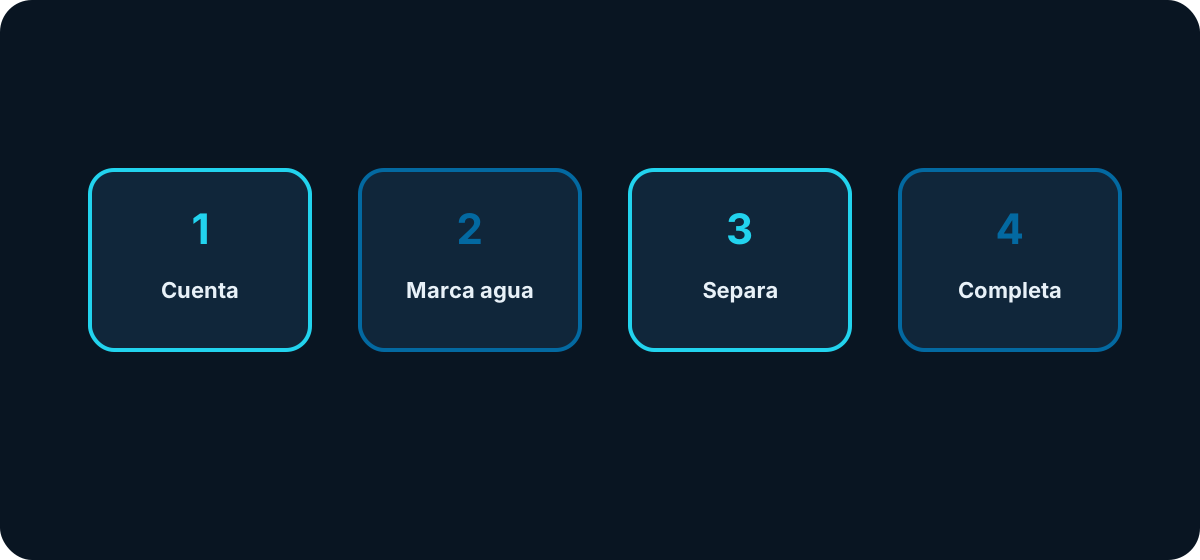
Start with zero lines and mark all their cells as water. Complete rows or columns whose totals are already satisfied. Clear diagonals around known ship cells. Then look for lines where open cells exactly match the number of missing segments.
Finally compare partial ship groups with the remaining fleet. This often creates new completed lines and lets the cycle begin again.
Size and difficulty are independent
Battleship offers four sizes and four difficulty levels. A larger board creates more hiding space, but board area should not be the only source of challenge. The distribution of givens and the interaction of clues determine how much indirect reasoning is required.
Keeping those controls separate lets you learn on a large board with more support or play a compact game in which every move depends on several constraints.
What makes a satisfying board
A good Battleship does not collapse by reading one row from left to right. Information travels between rows, columns and fleet inventory. Water in a corner changes a column; the column forces a segment; that segment clears diagonals; a cleared diagonal changes another row.
When that propagation works, the puzzle has rhythm. Each move is justified and also prepares the next one.
Different from Nonogram despite familiar counters
Battleship shares side numbers with Nonogram, but their meaning is different. Here marked cells form objects with specific lengths and separation rules. Meeting counts is only part of the task; the result must also reconstruct a valid fleet.
It also connects to placement puzzles such as Tents and Trees or Thermometers, where placing one object changes the legal space around it. That makes it a useful bridge between numerical and spatial deduction.
The fleet as an inventory, not decoration
The fleet panel behaves like a list of remaining pieces in a placement puzzle. Knowing that one length-four ship, two length-three ships or several single-cell ships remain changes how confirmed groups are allowed to grow. A shape is not enough to “look like a ship”; it must correspond to a real piece still available in the inventory.
When a confirmed group reaches the length of a remaining ship and mandatory water proves it cannot extend, that piece can be treated as complete and mentally removed from the inventory. This simplifies the rest of the board. Conversely, if only one long ship remains and only one open region can contain it, that region becomes a priority.
This is what separates Battleship from a pure counting puzzle. Edge totals describe occupied cells; the fleet describes how those cells must be grouped.
Water around a completed ship
Once a ship is proven complete, every surrounding cell that is not part of it must be water, including diagonals. Closing a ship therefore creates a large burst of information. A length-three ship occupies three cells but also blocks a ring around itself that may affect several rows and columns.
The important caution is timing. A partial group may still need to extend through one endpoint. Marking water there too early would destroy a valid solution. The right question is whether length, inventory and surrounding constraints prove that the group can no longer grow.
When they do, filling the surrounding water is usually one of the most productive moves in the puzzle.
Reading revealed ship segments
A revealed ship cell can tell you more than simple occupancy. Its position and nearby water may suggest or force orientation. If the cells above and below are water, the ship must extend horizontally unless it is a single-cell ship. If the remaining fleet rules that possibility out, orientation is proven.
Reveals become especially powerful near edges. A segment in a corner has fewer possible directions; combined with diagonal separation and low line totals, it can structure an entire region.
Treat every revealed segment as a node from which three kinds of information propagate: occupancy, separation and possible continuity.
Rows and columns answer one another
Edge counters create a constant conversation between the two axes. If a row reaches its total, every remaining cell is water. That water can reduce a column until all of its open cells must be ships. New ship segments clear diagonals, and those diagonals may complete another row.
Good boards produce chains like this. You should not solve all rows and then all columns. Every move belongs to both directions. When one region appears stalled, changing orientation often exposes a consequence that was easy to miss.
The habit is simple: after every new ship segment, inspect its row and column; after every important water mark, do the same.
The special case of nearly full lines
If a ten-cell row needs seven ship segments and already contains three confirmed water cells, every other cell is ship. The arithmetic is obvious, but the result may be geometrically complex because those seven cells cannot form any arbitrary pattern. They must be partitioned into the remaining ships without touching illegally.
After completing a line by count, immediately inspect the groups. The quantity can be correct while an extension creates an oversized ship or diagonal contact. Counters and fleet validate different layers of the state.
A strong Battleship move often satisfies both layers simultaneously.
Spaces where a ship no longer fits
The fleet can also exclude regions. If a length-four ship remains and an open corridor contains only three consecutive cells before water or an edge, that corridor cannot host it. If no shorter compatible ship remains, some cells in that corridor may be marked as water.
This capacity reasoning becomes important on harder levels, where line totals alone may not force a cell. Asking which pieces can still fit which gaps turns board geometry into logical information.
It resembles packing: every placement consumes space that another remaining length will no longer be able to use.
Why completing ships by visual intuition is dangerous
When two aligned segments appear, the eye naturally wants to finish the shape. But the inventory may allow them to be only part of a longer ship, and surrounding unknowns may still matter. Visual intuition is useful for deciding where to inspect, not for proving a move.
Before extending, state the reason. Does the row still require more segments? Is the opposite endpoint blocked? Does the only compatible remaining fleet length require growth? If no rule forces the extension, leave the space unresolved.
This discipline prevents expensive mistakes because one incorrect ship segment also creates false diagonal water and contaminates several nearby clues.
A game as the gradual reduction of open sea
At the start almost everything is unknown. Zero lines, revealed water and initial segments create islands of certainty. The board then separates into regions where particular ships can or cannot fit. Near the end, the question changes from “where could a ship be?” to “how exactly can the remaining fleet occupy the few gaps left?”.
That shift makes the endgame feel different from the opening. Early play is dominated by extreme counters and separation. Late play is dominated by inventory, length and capacity. A good human solver changes tools as the board changes.
The satisfying finish comes when the last piece is not guessed but becomes inevitable because every alternative has been removed for a clear reason.
An example where inventory determines orientation
Suppose the remaining fleet contains one length-three ship and two single-cell submarines. Two consecutive ship cells are confirmed in a row and vertical neighbours around them are water. The group cannot be a submarine and cannot bend; if the only remaining long ship has length three, it must extend by exactly one horizontal cell. Inventory turns a visual possibility into a requirement.
Once that third cell is placed, the entire ring around the completed ship becomes water. That water may satisfy nearby line totals and create new deductions. A fleet-based conclusion propagates back into edge arithmetic.
Finding spaces reserved for long ships
On harder boards, look for sufficiently long corridors before the puzzle is nearly complete. If only one region can still host the longest remaining ship, you may not know its exact position, but that region must preserve enough continuous space. Marking water that cuts it apart can be impossible even if a local line total would otherwise allow it.
This capacity reasoning works in both directions: it protects spaces that must remain available and rejects regions too small for the remaining pieces. It is a global tool comparable to subloop control in loop puzzles.
The difference between a conflict and a deduction
If a mark produces a visible conflict, that proves the mark cannot remain, but a strong solve aims to reach the conclusion before committing the error. Conflict feedback is a safety net, not the main technique. The useful question is which rule already made the placement impossible.
Using automatic checking to validate every hunch turns the game into trial and error. Using it to catch an accidental tap or review a complicated region preserves the deductive character.
Accessibility on a three-state board
Ship and water states need to remain distinct without relying only on colour. Symbols, state labels and controls should still work with keyboard input and on smaller screens. Reverse cycling through secondary click or Shift + Space avoids forcing users through all three states when correcting a mark.
Accessibility is not separate from logic here. If a cell state cannot be recognised reliably, human counting becomes unreliable too. A precise puzzle requires an equally precise interface.
Practising with the remaining-fleet view
When learning, pause every time a ship is completed and explicitly recount the fleet. This feels slow at first but builds an internal sense of which lengths remain possible. On larger boards, that awareness prevents many speculative extensions.
After a few games, the inventory becomes part of normal board reading rather than a separate panel you remember only near the end. That shift is one of the clearest differences between beginner and confident Battleship solving.
Combining line capacity with fleet length
Edge totals tell you how many segments remain in a line, but not how they are grouped. If a row needs four more ship cells and the open spaces are split into two adjacent cells in one area and two isolated cells elsewhere, the remaining fleet may decide whether that distribution is possible. If a length-three ship still has to be placed, the row may need to preserve a longer corridor and one assumed water mark may deserve rechecking.
This prevents you from treating rows as pure sums. Every occupied cell belongs to an object, and those objects have limited lengths. The interaction between quantity and shape is where harder boards become interesting.
When a line admits many numerical configurations, ask which of them can actually be decomposed into the ships still missing.
Diagonals as second-generation information
A diagonal water mark usually does not come directly from a row total; it is generated by an already confirmed ship segment. That secondary water can later become primary information for another row or column. Rules therefore create layers: ship → diagonal water → reduced line capacity → new ship.
Recognising these chains stops you from undervaluing a small water mark. On dense boards, one diagonal can be the fact that completes a nearly full line.
After confirming a ship or partial ship, inspect not only its endpoints but also the effect of its diagonals on nearby totals.
Solving from the remaining fleet back into the board
Near the end, reverse your perspective. Instead of asking what each cell may contain, ask where each remaining ship can still fit. If one length-three ship remains and only two valid corridors are long enough, any clue that eliminates one corridor fixes the other.
This global approach reduces the search space dramatically when many row and column quotas are already close to complete. The fleet stops being a final checklist and becomes the main engine of the endgame.
Single-cell submarines matter too. They can occupy isolated gaps that no long ship can use, and the number remaining tells you how many such gaps need to stay available.
Practising without turning the game into trial and error
To improve, try solving some boards while limiting the Check function to deliberate review points. Before marking a cell, name the reason: counter, diagonal separation, ship continuity, remaining length or capacity. This exposes the places where intuition is still replacing deduction.
When an error occurs, Undo to the first mark without a clear justification rather than only fixing the final conflict. Battleship propagates consequences quickly, so an early mistake may look harmless for many moves.
The goal is not to play without mistakes. It is to make every correction reveal which constraint was missing from your reasoning.
Why four sizes are useful for learning
Smaller boards make fleet-capacity deductions easier to see because a single water mark affects a larger fraction of the space. Larger boards create more independent regions and make inventory management more important.
Keeping difficulty stable while changing size is therefore a useful exercise. It shows which techniques depend on board scale and which remain constant across the entire game.
A reliable end-of-game review
Before considering the board finished, check four layers independently: every row total, every column total, the exact fleet composition and separation between ships. Satisfying three out of four is not enough.
This layered review is useful even when the interface can validate the result automatically. It makes clear which rule certifies which part of the structure and helps identify where a bad deduction entered the solve.
In particular, a board with correct counts can still be invalid if two ships touch diagonally or if a connected group has a length that does not exist in the remaining fleet.
Choosing a size to learn fleet reasoning
Small boards make the relationship between a placed ship and the space it blocks around itself easier to see. They are useful for internalising diagonal separation and fleet inventory. Larger sizes introduce more independent regions and make preserving corridors for long ships increasingly important.
Keeping difficulty stable while increasing size lets you practise spatial management without also changing clue density. Keeping size stable while raising difficulty practises deduction with less initial support. That separation turns the game settings into a learning path.
The goal is not to memorise fleet layouts but to recognise which spaces remain compatible with the pieces still missing.
Keep exploring
The Battleship: finding a fleet without blind guessing page links to nearby games that use similar skills in a different form. Moving between them is a useful way to notice which techniques transfer and which belong specifically to this rule set.
The goal is not to memorise a trick. It is to learn how local constraints accumulate until a move becomes inevitable. That is the common language behind many of the logic games in Blupoli Puzzles.