
One loop and one balancing rule
Balance Loop asks you to draw a single closed circuit with no branches or crossings, passing through every circle cell. That sounds familiar if you play loop puzzles. The distinctive rule appears when each circle measures how far the line travels before its next turn in both directions.
At a white circle those two straight runs must have equal length. At a black circle they must differ. If a number is present, it gives the sum of both lengths. One clue can therefore combine geometry, distance and global continuity.
Measuring to the next turn
The relevant run does not stop when it passes through another circle. It continues until the loop changes direction. A long straight can therefore participate in several clues. It helps to imagine every circle as the meeting point of two straight “arms”, one entering and one leaving.
This produces useful local deductions. A white circle near an edge cannot have one arm longer than the space available to its opposite arm. A black circle rejects equal pairs. A numbered circle limits the possible partitions of its total.
White circles: equality as a tool
White clues are good starting points because they convert space into a comparison. If the left side can only extend two cells before a forced turn, the right side must also extend two. Once one direction becomes fixed, the other often follows.
In narrow corridors this symmetry can force segments immediately. In open areas it may not determine orientation, but it still rules out turns that are too close or too far away.
Black circles: proving inequality
A black clue does not tell you which arm is longer. It only says that they cannot be equal. That sounds weaker, yet it becomes powerful once one side is nearly fixed. The other side is then forbidden from matching it.
Numbers sharpen the rule. If a black circle totals six, for example, the split 3+3 is impossible before any geometry is considered. A qualitative condition becomes a concrete numerical exclusion.
The number does not replace the colour
A numbered circle still remains white or black. The sum condition and the equality or inequality condition apply together. Their intersection can reduce possibilities dramatically and often anchors an entire region of the board.
Strong solving comes from reading clues as systems rather than labels. The number provides candidate pairs, the colour removes some pairs, and board geometry removes the rest.
The global rule always wins
Local clue logic is never enough on its own because the final answer must be one loop. Closing a small circuit that satisfies three nearby clues is still wrong if other circles remain outside it. Likewise, a branch with three connections can never be repaired later.
This global condition ties distant regions together. A segment may look perfect by length and still be impossible because it would isolate part of the route.
Marking the board
Each potential segment cycles through empty, line and ×. The cross records that a connection cannot belong to the loop. You do not need to mark every absence, but doing so at critical junctions reduces visual noise and prevents the same option being reconsidered repeatedly.
Undo, Redo, Clear, Hint and Restart let you explore without turning interface mistakes into lost progress. The intended work is logical, not clerical.
Four sizes and four difficulty bands
Balance Loop exposes four board sizes and four difficulties. Size changes the room available for long runs, detours and distant interactions. Difficulty changes how much information must be combined before a segment is proven.
Learning on a small board is useful because it makes the arm-length rule intuitive. From there you can raise size without necessarily raising difficulty. Keeping the controls independent separates “more board” from “more reasoning”.
A routine for stalled positions
Begin with numbered circles and white circles near edges. List the plausible length pairs mentally. Then look for segments that would create a branch or close a loop too early. Finally return to black clues whose neighbourhood has changed.
When one region refuses to move, inspect the global circuit. Sometimes the decisive fact is not inside the circle at all, but in the need to preserve an entrance and an exit so the loop can reach the rest of the board.
How it relates to other loop puzzles
Slitherlink players will recognise the danger of premature closure, but Balance Loop places clues on the route and talks about straight-run lengths. Masyu also uses circles to constrain line shape, though its logical language is different. Numberlink shares route planning but builds several paths rather than one circuit.
That is why Balance Loop sits naturally across loops, connections and numbers. None of those categories alone captures the whole puzzle.
Why balance remains readable
Many deductions can be explained in one sentence: “if it turns here, the opposite arm can no longer match”, “if this side is three, the other must also be three”, or “this total only allows these splits”. That readability keeps a strong connection between rule and move even on harder boards.
The challenge is not to discover a hidden rule. It is to make several simple rules coexist inside one continuous loop.
The geometry of arms and forced turns
Balance Loop becomes much clearer when you stop thinking about isolated line segments and start thinking about straight arms extending from each circle. A horizontally crossed circle has one arm to the left and one to the right until the next turn; a vertically crossed circle has arms above and below. Colour compares those lengths, while a number—when present—restricts their sum.
This mental model makes the edge of the board an additional source of information. If a white circle is two cells from the left boundary and the route cannot turn earlier, the opposite arm cannot exceed two before its corresponding turn either. If the circle is black, that exact equality is forbidden. Board geometry turns an abstract rule into concrete distances.
Turns also connect clues. A bend fixed by one circle may become the length boundary for another circle along the same straight line. A local deduction can therefore propagate information several cells away without directly touching the second clue.
Using numbers as partitions
When a numbered clue gives a total, translate it into possible pairs. A total of five can be split into 1+4, 2+3, 3+2 or 4+1. Colour removes some pairs: a white circle only accepts equal lengths, while a black one rejects equality. Available space removes more.
You do not need to write every partition down, but thinking in those terms is useful. If one arm is forced to length two and the total is seven, the other must be five. If geometry cannot provide five straight cells, the assumed orientation is impossible. The number becomes a way to test orientations without tracing the whole loop.
On harder boards, several numbered clues can share straight runs. Fixing one length automatically reduces the possible partitions of the next clue, creating a chain of arithmetic over geometry.
Premature subloops: the most tempting global mistake
One of the most common errors in any loop puzzle is closing a valid-looking circuit too early. Balance Loop makes this especially tempting because a small closed shape may satisfy several local length clues perfectly. If other circles remain outside it, however, the state is already impossible: the final answer must be one loop.
A good habit is to inspect any move that completes a local closure. Before drawing the last segment, ask whether other regions still need to join the route. If they do, that closure is forbidden no matter how satisfied nearby clues appear.
The same global logic can force moves positively. If a region has only two remaining ways to connect to the rest of the board, preserving both connections may become mandatory. Connectivity does more than reject mistakes; it can determine structure.
Degrees: a simple language for every cell
Every cell used by the loop ends with exactly two connections. An unused cell has zero. A valid solution never leaves one or three. Thinking in terms of this degree is extremely practical. If a cell already has two segments, every other incident edge is ×. If a required loop cell has only two viable exits left, both are forced.
Circle cells always belong to the route, so the degree rule applies to them immediately. Ordinary cells require a little more care because they may remain unused, but connectivity and subloop avoidance usually clarify the choice.
This language also explains why a branch is not a temporary state that can be repaired later. The moment a cell would have three connections, no valid final loop can contain it.
Why white clues strengthen near edges
Equality needs two compatible spaces. Near a boundary, one arm has a small maximum and that limit transfers directly to the other. In the centre, many equal-length pairs may remain possible. This makes white circles close to edges excellent starting points.
If a number is present, the deduction can become immediate. A white circle totalling six requires 3+3. If one orientation cannot provide three straight cells on both sides, that orientation is eliminated. You are not trying a path; you are comparing a required length with available geometry.
This style of deduction captures the character of Balance Loop. Numeric and spatial logic are not separate layers. Each translates the other.
Why black clues often become strong later
Black circles usually need context. At the beginning they only tell you that the arms differ. Later, once a turn is fixed or a sum reduces the options, inequality becomes specific. If one side is three, the other may take many values except three; with a total of seven, however, it is immediately four.
This makes black clues excellent finishers. A quiet region can unlock as soon as one length arrives from elsewhere. It is therefore worth revisiting black circles periodically rather than dismissing them as vague.
Higher difficulty often comes from this timing. A clue that contributes almost nothing at the start can become decisive several moves later.
Reading a long straight through several circles
Passing through another circle does not end the measurement; only the next turn does. That detail creates interesting structures because one straight run can serve as an arm for several clues. Two white circles sharing a line may connect equalities on both sides and form a chain of geometric equations.
It also means you should not mentally cut the route at every circle. The relevant object is the complete straight section between bends. Keeping confirmed turn locations in mind makes counting easier and prevents off-by-one mistakes.
Moving one bend can change several clues at once, which is one reason the puzzle can be deep without requiring a huge board.
A working sequence for harder levels
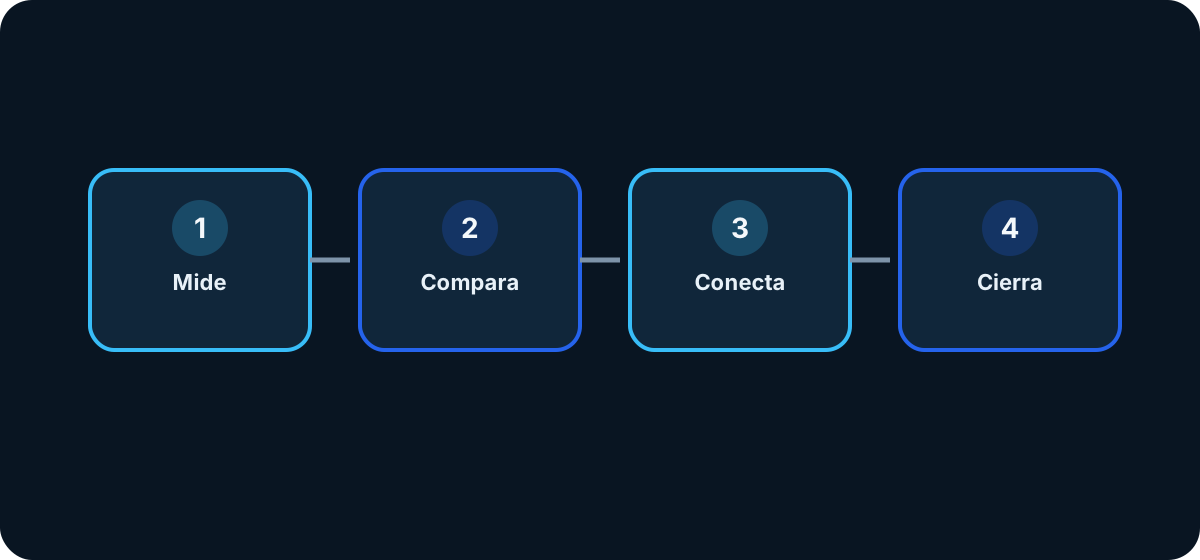
On Hard and Expert, alternate four scans. First inspect numbered clues and possible length partitions. Second inspect cell degrees: places with two lines already or with only two viable exits. Third check for premature closures and connections between components. Fourth revisit white and black circles whose surroundings changed.
The order is not mandatory, but it stops you from staring at only one kind of information. Balance Loop distributes logic across arithmetic, local geometry and global topology. Focusing only on numbers misses connectivity; focusing only on the route wastes the balancing rules.
With practice these scans merge into one flow. A length forces a bend, the bend completes a degree, the degree prevents a subloop, and that prohibition determines another length. That chain is the real heart of the game.
An example: solving a total without drawing the whole route
Imagine a black circle with total seven. Its arms differ and their lengths sum to seven. Relevant partitions are 1+6, 2+5, 3+4 and their reversed versions. If the upward direction can only remain straight for three cells before a forced turn, options requiring five or six there disappear. If the downward side is forced to turn after four, the pair reduces to 3+4 and orientation may become determined.
No complete hypothetical route was required. Sum, inequality and geometric capacity were enough. This style of reasoning keeps the puzzle deductive even while the global loop is still very open.
Using crosses with intention
× marks are most valuable at junctions where an absent edge changes degrees or prevents a premature closure. Marking every unused edge can saturate the board without improving clarity. By contrast, rejecting one connection around a circle may leave exactly two exits and force both remaining lines.
Good notation does not try to represent every edge outside the solution. It records the exclusions that still influence future decisions. That keeps the board readable and makes repeated scans faster.
Reviewing a solve after a mistake
If the loop reaches a contradiction, do not only search for the last wrong segment. Undo until you find the first decision that was not supported by length, degree or connectivity. A line can look harmless for several moves before geometry exposes the problem.
Using Undo to find that first leap of intuition teaches more than patching the final symptom. Balance Loop is particularly suited to this kind of review because almost every correct move can be expressed with a concrete reason.
Why the puzzle remains readable at higher difficulty
Harder boards do not introduce hidden exceptions. They reduce the number of immediate placements and increase the distance between one local fact and the next forced segment. The same three languages—length, degree and connectivity—continue to explain the solve.
This continuity matters for learning. Moving from Easy to Expert is an exercise in chaining familiar tools, not memorising a new rulebook. If Expert feels impossible, practising those three scans separately is usually more effective than searching for a special advanced trick.
Comparing orientations without committing
A circle may still allow horizontal or vertical passage before the loop is settled. You do not need to choose one in order to make progress. Compare what each orientation would require: available run lengths, numbered totals, equality or inequality, and the connections needed by the rest of the circuit. If one orientation creates an impossible arm or a premature closure, it is eliminated deductively.
This works especially well for numbered circles near obstacles. Instead of drawing a hypothesis and undoing it later, calculate its limits first. The reasoning is cleaner and easier to review.
If both orientations remain possible, leave them open. Balance Loop does not reward early commitment; it rewards keeping only compatible states.
Interactions between consecutive circles
Two circles on the same straight section may share part of the route, so their lengths are not independent. If the next bend lies beyond the second circle, both measure toward the same turning point in one direction. Equality at the first circle may therefore establish a distance that becomes input for the second.
A chain of white circles can propagate equal lengths across a large region. A black circle inserted into that chain can break symmetry and determine which bend must shift. These structures create elegant difficulty because several simple clues combine into a global consequence.
When inspecting a long straight, identify every circle whose measurement depends on its bends before changing it.
The endgame: connectivity before appearance
When only a few segments remain undecided, it is tempting to complete the picture according to what looks like a natural loop. The correct criteria are unchanged: valid degrees, every clue satisfied and one connected closed component. A visually smooth line can still create two separate circuits or leave a used cell with degree one.
Near the end, mentally trace the selected route from any point. If you return to the start without visiting another selected section, a subloop exists. If one region cannot be reached through the remaining undecided edges, a connecting segment is forced somewhere.
The elegance of the final loop is a consequence of the rules, not an extra rule of its own.
How difficulty changes the order of deductions
On easier boards, numbered or edge-constrained circles often produce immediate lengths. Harder boards delay those certainties, forcing you to use degree and connectivity information before returning to the measurement clues. The rule set remains the same, but the order in which tools become useful changes.
This is a healthy kind of difficulty because learned techniques remain valid. Expertise comes from recognising which tool is currently informative rather than from memorising exceptions.
Practising turn-point reading
A useful way to train Balance Loop is to ignore long line segments for a moment and focus on where the next turn from each circle could occur. Colour and numbers restrict those turning points before the complete route is known.
When two circles share a straight run, comparing their possible bend locations often produces more information than deciding edges one at a time. This turn-based view complements degree reasoning and reveals deductions that detailed line drawing can hide.
With practice, the board starts to look like a set of possible turning points connected by mandatory route structure rather than a large collection of independent edges.
Choosing size and difficulty for learning
Small boards make run lengths and premature closures easy to visualise, so they are ideal for learning how to measure arms. Once that reading becomes automatic, increasing size introduces longer straight sections and interactions between distant regions. Raising difficulty instead reduces immediate decisions and requires more combination of information sources.
Changing only one variable helps identify the missing skill. If a large Easy board is difficult, the problem may be geometric management. If a small Expert board stalls, practise the interaction between clue lengths, degrees and connectivity.
This separation keeps progression understandable even as the final loop becomes much more complex.
Where to go next
If this style of deduction works for you, continue with the related games linked from the Balance Loop: a loop that also has to measure itself page. Blupoli groups games by the kind of reasoning they ask for, so moving from one puzzle to another is a way to compare techniques rather than just change the decoration.
The important point is not to solve quickly. It is to understand why a candidate, line or position has become impossible. Once that habit is established, harder boards stop looking like larger walls of information and start behaving like chains of small, checkable decisions.