
Large-scale relational deduction
Zebra Grid turns the familiar “who belongs where?” style of logic puzzle into a large matrix of categories and positions. Every row contains one complete category and every symbol in that category must appear exactly once. Columns are shared positions. Solving means discovering which symbol occupies each one.
Unlike a prose riddle, the information is visual and directly editable. You do not need to build a separate logic table on paper: the board already is that table. Select a position, inspect candidates and remove them until the structure becomes determined.
Relational clues that become stronger together
Clues can fix a position, put two symbols in the same column, keep them apart, require or forbid adjacency, impose left-to-right order, require immediate-left order, or place one symbol between two others. No single family is difficult to understand. The challenge comes from intersections.
A negative clue can look weak at first. “A is not with B” removes one pairing. But once B has only two columns left and another clue restricts A, that negative statement can resolve both rows. Zebra Grid is built around this kind of rereading.
The board is large because the puzzle needs room
Available sizes are 6×6, 8×8, 10×10 and 12×12. On desktop the clue list sits in a separate column so that it does not steal space from the matrix. On mobile the layout reflows while keeping symbols and numbers large enough to remain useful information rather than tiny decoration.
This scale matters. A relation puzzle stops being playable when the interface asks the player to identify microscopic icons. Every candidate should be recognisable and tappable without pixel-perfect accuracy.
Working with candidates
Selecting a cell opens a tray containing the symbols for that category. You can remove candidates one by one, restore them after a mistake or confirm the chosen option directly with a double click. Once only one candidate remains, the position is solved.
This keeps the logic explicit. You are not writing an opaque answer; you are recording what remains possible. On a 12×12 board that record is essential because an exclusion made ten minutes earlier may be exactly what a newly reread clue needs.
A solving routine that scales
Start with direct clues: fixed positions, same-column relations and adjacency. Then look for exclusions that become stronger near edges. Scan every row for a symbol with only one possible position. Whenever you confirm something, immediately revisit the clues involving that symbol.
On a large board there is little value in rereading every clue after every move. Follow the wave of a deduction instead: a confirmation affects a small set of relations, those relations remove candidates, and those removals may solve another cell.
Unique solutions and a logical solver
Generation is deterministic for a given seed. Tests verify that every generated clue is true for the hidden solution, that the logical solver can finish without guessing and that solution counting returns exactly one completion.
This creates a useful contract with the player. If you are stuck, random trial is not the intended escape. A deductive chain exists. On Expert it may be long, but the puzzle is not asking for a coin flip.
Difficulty based on structure
Easy, Medium, Hard and Expert are separated by a difficulty score and by the composition of clue types. Tests require the score to rise from band to band. Expert lowers the ratio of direct clues and gives more weight to chained relations such as “between”.
That avoids a common shortcut: calling a board expert simply because it is larger. Size and difficulty are independent controls. You can learn the language on a demanding 6×6 or enjoy a roomy 12×12 Easy without conflating the experiences.
Why negative clues matter so much
At the beginning we naturally search for statements that tell us what is true. In practice, negative relations often clean up more of the board. If two symbols cannot share a column and one of them has already been reduced to two positions, a general prohibition has become an almost concrete placement rule.
The trick is not to judge clues in isolation. A weak clue can become the strongest clue on the board after three confirmations somewhere else.
Zebra Grid compared with Logic Matrix
Both games share a candidate-grid foundation but aim for different experiences. Logic Matrix uses a small set of graphical clues, two reading axes and sizes from 4×4 to 7×7. Zebra Grid embraces scale: more rows, more positions and a broader visible clue language.
If Logic Matrix feels like opening a compact mechanism, Zebra Grid feels more like managing an investigation. There is more open information and the skill lies in knowing what to reread next.
What to do when a row appears frozen
Do not force it. Move to another category. Many rows are solved from the outside: a clue elsewhere fixes a column, that column eliminates a candidate here, and suddenly one position becomes unique. The design rewards circulation around the matrix.
Columns deserve attention too. Every column must contain one symbol from each category. A heavily constrained column can be just as informative as an almost complete row.
A puzzle for longer sessions without losing the thread
Larger sizes support a slower, more deliberate session. Persistent state, Undo, Redo, Clear, Restart and hints make it possible to return without turning the interface itself into part of the challenge.
The difficulty should live in the relationships, not in remembering which button you pressed or which symbol you removed by accident. That principle guides the way Zebra Grid fits inside Blupoli Puzzles.
Organising information once the board no longer fits in your head
The main difference between a small Zebra Grid and a 10×10 or 12×12 board is not that the rules become more complicated. The amount of active information quickly exceeds what is comfortable to hold in memory. That is why the candidate interface acts as a permanent notebook. Every exclusion remains visible and every solved position reduces the visual load of the rest.
A useful technique is to think in solving fronts. Instead of trying to advance every category at the same pace, follow one chain of relations while it continues to produce information. When it stalls, move to another region. A deduction elsewhere may reactivate the first front later. This approach avoids rereading the complete clue set after every move.
On desktop, keeping clues in a column to the left of the board helps separate two kinds of information: relations that still need interpretation and state already recorded in the matrix. On mobile, where the same width is unavailable, the layout prioritises keeping both readable even when they must be arranged in separate blocks.
Direct relations and relations that need context
Clues do not all have equal strength at the beginning. A fixed position or same-column relation may reduce candidates immediately. Non-adjacency or different-column clues can look almost decorative. That ranking changes during play. A negative clue involving two wide-open symbols is weak; the same clue becomes decisive when one of those symbols has only two positions left.
Recognising this change in strength prevents you from giving every clue equal attention. Relations involving recently changed symbols deserve another look first. If one row has just lost several columns, every clue touching that row may have become more informative.
This is particularly important on higher difficulties. Expert does not hide extra rules. It uses a clue mix in which direct relations solve less on their own, so accumulated consequences matter more.
The value of a “between” clue
Three-item relations add structure because they do more than connect a pair. When one symbol must sit between two others, the middle item cannot occupy an edge, the outer items must fall on opposite sides, and the available distances restrict combinations. If any of the three symbols loses positions, the whole relation can contract quickly.
On large boards this clue acts like a small system within the system. It may not give an absolute position, but splitting the board into left and right can be enough to activate order or adjacency clues elsewhere. Difficulty tests require Expert boards to use this kind of structure with more weight while relying less on direct clues.
Strong Zebra Grid solving means valuing clues by how much possibility space they remove, not by whether they produce an answer immediately.
Rows and columns tell different stories
A row represents a category and contains all its symbols exactly once. A column represents a position and collects one symbol from every category. Looking only at rows gives an incomplete view. A category may remain wide open while one particular column has become so constrained by other rows that only one combination fits.
After solving several cells, make a vertical pass. Which columns already have many confirmed positions? Which symbols from the remaining rows can still fit there? This changes the question from “where can this symbol go?” to “what can occupy this position?”. The two are mathematically equivalent but visually different.
Many strong advances appear when alternating these views. A horizontal deduction cleans a column; the column forces a cell; the cell then strengthens another horizontal relation.
Why a 12×12 board needs both design and performance work
Increasing size is not just changing a constant and drawing more cells. The generator must produce enough useful relations without letting sampling costs explode. Difficulty scoring must remain stable. The solver must still prove uniqueness within a reasonable budget. And the interface has to respond without turning every action into a pause.
Recent work explicitly bounded relation sampling and optimised large-board generation. At the same time, E2E coverage includes the 12×12 board on mobile. That combination matters because an engine can be algorithmically correct and still provide a poor game if generation is slow or the board becomes unreadable.
Publishing a new size therefore requires two answers: does the puzzle remain valid, and can people actually play it on the devices the platform supports?
Distinguishing a strong deduction from intuition
On a large matrix it is easy to start feeling that a symbol “probably” belongs in a column. Intuition can help decide which clue to inspect, but it should not become a move on its own. A strong deduction can be written as a checkable chain: this relation removes two positions; this row has already used that symbol; this column leaves only one option; therefore this cell is fixed.
Verbalising the chain helps prevent errors and makes each clue more teachable. If the reasoning cannot be explained without words such as “seems” or “probably”, keep reducing candidates instead.
The candidate interface supports exactly that behaviour. There is no penalty for leaving a cell unresolved for a long time. The goal is not to fill space quickly. It is to close only what has been proved.
Common mistakes on large boards
The first mistake is trying to finish one category before looking at the rest. Zebra Grid is built around rows helping one another. The second is ignoring negative clues because they appear inactive. The third is failing to revisit a clue after one of its symbols becomes nearly fixed.
Scale can also hide deductions visually. If a number or clue icon is too small to read comfortably, it stops functioning as practical information. Recent interface work increased text, number and symbol sizes and gave the board space comparable to other grid puzzles in Blupoli.
Legibility is not cosmetic in a logic puzzle. It is part of the human solving algorithm. If a relation cannot be inspected comfortably, the extra difficulty comes from the interface rather than the puzzle.
A 12×12 session without chaos
Start by creating structure. Resolve fixed positions and the most direct relations. Then choose two or three categories with the richest information and follow them until they stall. Scan partially solved columns. Return to negative and three-item clues. Repeat.
This cycle avoids the need to “read everything” continuously. The puzzle becomes a sequence of small contexts: this pair now, this column next, this three-symbol relation afterwards. The matrix stores the rest of the state for you.
In that sense Zebra Grid rewards information management more than speed. Large size is not intended to overwhelm. It creates room for longer logical chains and for moments when one local deduction suddenly unlocks a region that seemed unrelated.
Prioritising clues in a long list
On 10×10 and 12×12 boards, rereading every clue from top to bottom after each move is too expensive. Use a dynamic priority instead. Fixed-position and same-column clues come first. Then revisit relations whose symbols just lost candidates. Negative clues that still operate on very wide domains can wait.
This does not change the rules; it changes how attention is spent. A large puzzle becomes manageable when the solver treats attention as another limited resource. The best clue is not always the strongest in the abstract, but the one interacting with a state that just changed.
A simple mental note—“these three clues depend on the symbol I just fixed”—can save a complete scan of dozens of unrelated relations.
An example of propagation across categories
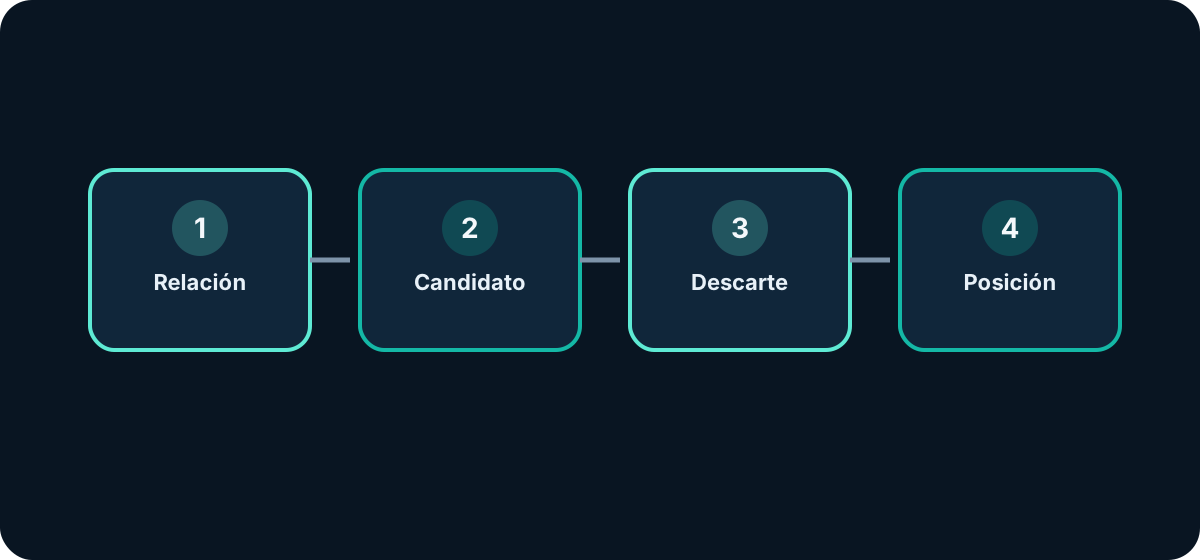
Suppose an animal becomes fixed in column seven. A clue says a fruit is adjacent to that animal, so the fruit is now in six or eight. Another relation puts the fruit left of an instrument. If the instrument can no longer occupy seven or eight because of its own row constraints, the fruit becomes fixed in six. That confirmation removes it from every other position and may leave another column with only one option in the fruit category.
The chain crosses three categories, yet every step is local and checkable. This is the kind of structure that makes a large Zebra Grid interesting: visual distance does not mean logical independence.
Candidate recording lets you follow such chains without memorising the whole board. Every step leaves a trace that simplifies the next.
When to use a hint
Help is most useful after your normal scans are exhausted and you want to identify the kind of deduction you are overlooking. Used as a continuous advance button, it removes the information-management skill that defines the game.
A good routine is to request one hint, observe which candidate changes and then reconstruct the reason before continuing. Which relation made that position impossible? What other board fact did the clue need? Turning system help into your own explanation makes the next similar case easier to recognise.
Undo and Redo are equally useful for investigating mistakes without destroying a long session. On 12×12, preserving correct work matters a great deal.
Performance should not masquerade as difficulty
A slow generator can make a level feel heavier than its logic actually is. Likewise, an interface that delays candidate updates breaks the continuity of deduction chains. Performance and puzzle difficulty therefore need to remain separate: challenge should come from relationships, not waiting.
Recent sampling and scoring optimisations keep large-board generation bounded. Mobile E2E coverage at the maximum size protects the other side of the experience: the generated board still needs to be playable.
When both layers behave well, a 12×12 board can be long without feeling clumsy. That distinction is essential if “large” is meant to describe more logical space rather than more friction.
How to review a completed solve
After finishing a large grid, look back at where the board accelerated. Usually one or two confirmations caused several categories to collapse. Identifying those pivot points helps reveal which clue types you were underusing earlier.
If most progress came only after hints, inspect the preceding state rather than the final move. The missing technique may have been a row uniqueness scan, a column perspective or a negative relation that had recently become strong.
Reviewing solves in this way turns large boards into practice rather than isolated endurance tests.
Using the candidate tray as an external memory system
On the largest boards, candidate management is not a secondary convenience; it is part of the solving method. The tray lets you turn a vague thought such as “this symbol probably cannot be here” into an explicit exclusion that remains visible ten minutes later. That record matters because large relation puzzles frequently depend on deductions made far apart in time.
A useful discipline is to record only conclusions you can justify. The tray then becomes a trustworthy external memory rather than a mixture of facts and guesses. When a cell finally reaches one candidate, you know the confirmation is the accumulated result of earlier deductions rather than a speculative choice.
This also makes returning to a paused game easier. You do not need to reconstruct every thought that led to the current state; the reduced domains already capture most of that work.
Separating board size from reasoning difficulty
A 12×12 Easy board and a 6×6 Expert board should feel different for reasons other than the number of cells. The large Easy board asks you to manage more information but provides more direct relationships. The small Expert board may contain fewer symbols while requiring longer chains and less obvious clue interactions.
Keeping those dimensions separate is useful for practice. If you want to improve information management, increase size while keeping difficulty stable. If you want to practise deeper deductions, keep size familiar and raise difficulty. Changing both at once makes it harder to understand what skill is being tested.
This separation is also valuable for generator quality because it prevents “bigger” from becoming a lazy synonym for “harder”.
A good way to learn the largest size
Before jumping directly to 12×12 Expert, try 12×12 Easy and Medium. The goal is to become comfortable with scale, desktop clue placement and candidate-tray navigation without adding the longest deduction chains at the same time. Once moving around the matrix feels natural, raising difficulty lets you focus on relationships instead of interface management.
The reverse experiment is equally useful. A 6×6 Expert board lets you practise complex clue interactions without tracking twelve symbols in every category. Separating these dimensions helps reveal whether a blockage comes from logic or information volume.
Independence between size and difficulty is therefore a learning tool, not merely a settings option.
Where to go next
If this style of deduction works for you, continue with the related games linked from the Zebra Grid: relational deduction at full scale page. Blupoli groups games by the kind of reasoning they ask for, so moving from one puzzle to another is a way to compare techniques rather than just change the decoration.
The important point is not to solve quickly. It is to understand why a candidate, line or position has become impossible. Once that habit is established, harder boards stop looking like larger walls of information and start behaving like chains of small, checkable decisions.