
Clasificar por cómo pensamos
When a catalogue contains a dozen games, a list can be enough. People recognize a few names, open something familiar and gradually learn the rest. Once the catalogue grows into dozens of puzzles drawn from different traditions, mechanics and naming conventions, that approach stops scaling. By September 12, 2026, when Blupoli Puzzles was still called Blupoli, the problem was already visible: having more games was making it harder to choose one.
The answer could not simply be another row of cards. We needed classification to become a discovery tool. That means describing puzzles by how they play, what information they manipulate and what kind of reasoning they usually ask for, without presenting those categories as rigid scientific borders or as promises of cognitive improvement. The product question is much more practical: “what kind of challenge do I feel like playing right now?”
A category has to explain something
Labels such as Numbers, Paths, Shading or Logic are useful because they offer an immediate visual or mechanical cue. They become less useful when the label is the entire explanation. Someone who has never played Kakuro, LITS, Norinori or Kropki still does not know what they will actually do during a session.
A useful category needs context. It can explain the kinds of rules that tend to appear, the decisions that repeat, the mistakes players often make and the games that represent the family well. Classification stops being an administrative folder and becomes a genuine entrance into the catalogue.
The catalogue should work for people who do not know the names yet
Experienced puzzle players can navigate by proper nouns. Newcomers should not need to know what “Slitherlink” or “Norinori” means before discovering whether the experience interests them. Choosing only by title requires domain knowledge before the product has taught anything.
It is more useful to start from an intention the player already understands: “I want something numerical without heavy arithmetic,” “I prefer visual puzzles,” “I like building paths,” “I want pure deduction,” or “I only have a few minutes.” The specific title can come afterwards. Discovery should shorten the distance between an intention and a suitable experience.
Taxonomy should not become a cage
Many puzzles belong to more than one family. Kakuro is numerical and arithmetic, but it is also about combinations and elimination. Nonogram uses numeric clues to create a spatial image. Logic Grid is relational. Kropki combines number constraints with information encoded between cells.
Forcing every game into one exclusive label throws away useful information. The model that makes more sense for Blupoli is a primary category for navigation plus secondary metadata that can describe the experience in more detail.
The primary category answers “what do I see?”; metadata answers “what do I do?”
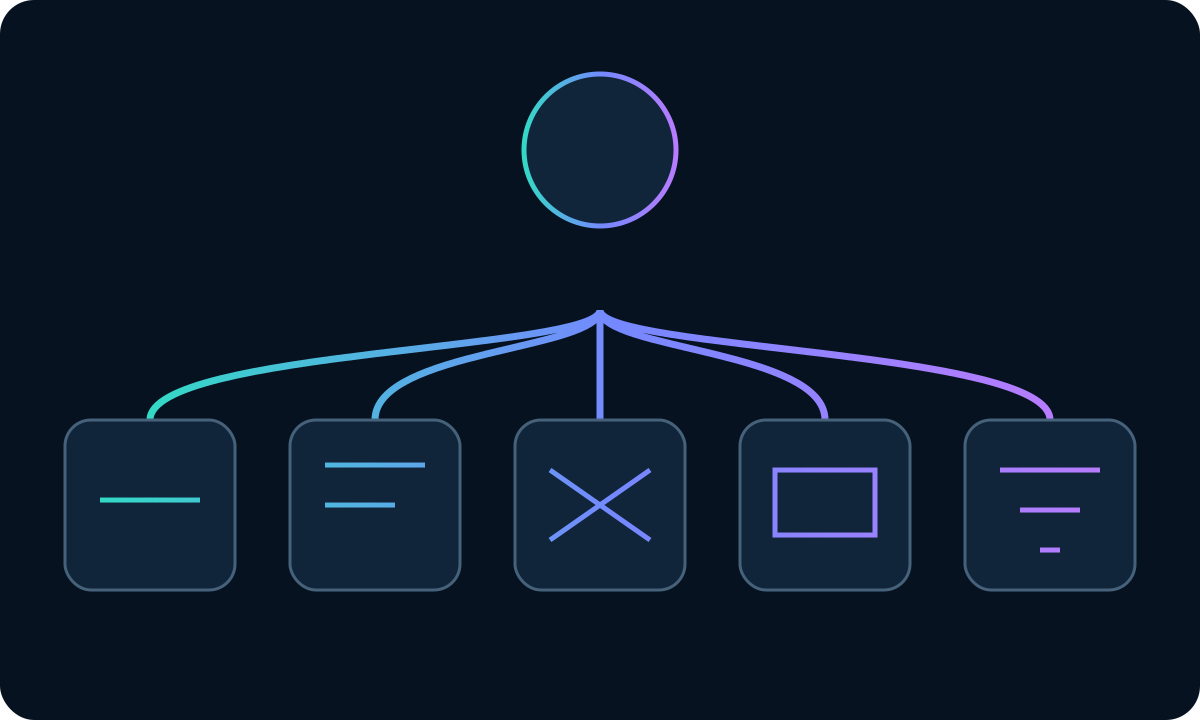
A visual family helps people recognize the surface quickly: numbers, regions, edges, paths, pieces or relationships. Mechanic metadata can go further: constraint propagation, spatial planning, counting, ordering, connectivity, matching or relational deduction.
Separating those layers matters because players may search through either one. Sometimes they want “something like Sudoku.” Other times appearance is secondary and they are looking for a reasoning pattern. The catalogue should support both journeys without making either person learn the internal data model.
Describing cognitive processes requires precision
It is reasonable to say that a puzzle uses sustained attention, working memory, mental calculation, spatial reasoning or planning when those activities are visibly part of play. It is a very different claim to say that playing the puzzle produces a clinical or broadly transferable improvement in those abilities.
Blupoli does not need exaggerated promises to explain why a mechanic is interesting. We can describe what the player actually does: hold candidates in mind, remember constraints, imagine a route, compare possibilities or chain deductions. That is useful orientation without turning the catalogue into pseudo-scientific brain-training marketing.
“Uses working memory” does not mean “improves your memory”
The phrases sound close, but the claim changes completely. If a puzzle asks a player to maintain several temporary possibilities at once, we can describe that demand. It does not automatically follow that the activity improves memory in unrelated contexts.
A stronger claim would require specific evidence that a game card should not invent. This restraint also makes the product more credible. A puzzle can be valuable because it is elegant, enjoyable or challenging. It does not need to become therapy in order to justify its place in the catalogue.
Attention looks different across mechanics
In one game, attention means scanning many small clues without missing an incompatibility. In another, it means following a spatial chain. A matching puzzle may require remembering which options remain available. A number grid may require switching between row, column and region constraints.
Calling all of that simply “attention” is too broad to communicate the feel of play. The term can still orient the player, but concrete examples are what make the description useful.
Deduction is common, but it is not one mechanic
Sudoku, Logic Grid, Dominosa and Slant can all be described as deductive puzzles. The object of deduction changes in each one. Sudoku eliminates values. Logic Grid eliminates relationships. Dominosa eliminates pairings. Slant eliminates diagonal choices while also protecting a global no-cycle rule.
That difference is part of the value of a broad catalogue. The label “deduction” should not flatten those experiences. It should create a route between them: if you enjoy ruling out possibilities inside a constrained system, here are several very different ways to do it.
Spatial reasoning deserves its own explanation
Some puzzles depend less on symbols and more directly on geometry. Fitting pieces, imagining connectivity, following regions or completing routes asks the player to reason through space itself. That does not make those games cognitively superior; it makes them different experiences.
A category can make that difference visible through examples. Triangle Blocks is about fitting shapes on a triangular grid. Waypoint revolves around paths. Jigsaw Sudoku keeps the core logic of Sudoku while replacing regular boxes with irregular regions.
Mental arithmetic is not the same as numerical logic
A grid can contain numbers without calculation being the central challenge. Sudoku uses digits mostly as unique symbols. Kakuro genuinely uses sums. Kropki uses consecutive and ratio relationships. Str8ts uses consecutive intervals.
This distinction prevents someone who says “I do not like maths” from dismissing puzzles where digits behave almost like labels. It also helps players who do want arithmetic find games where calculation is truly part of the mechanic.
Planning appears when one choice reshapes many later choices
Some puzzles are highly local and make it easy to reconsider a deduction. Others create a stronger planning pressure because one action changes the shape of all future options. Ball Sort and several connection games make that effect obvious.
A category can signal this without claiming to measure executive function. The player only needs to know that the game rewards thinking several moves ahead, preserving flexibility or anticipating how a decision will constrain the board later.
Relationships form a family that an alphabetical list cannot reveal
Logic Grid and the Einstein Riddle are built around correspondence: who belongs with what, which entity occupies which position and which relationships a clue rules out. Their interfaces can look very different from Sudoku even though both are strongly deductive.
Giving relational puzzles a visible place helps players who enjoy narrative clues, matrices and elimination between entities. It also creates a natural route to our article about the Einstein Riddle engine.
Connectivity cuts across paths, edges and graphs
Slitherlink, Waypoint, Numberlink and other route-based puzzles share an intuition: build or constrain a network. Even inside that idea, the global rule changes. One game may require a single loop, another a route and another connections between pairs.
“Paths and connections” can therefore be a friendly doorway, followed by the specific rule of each title. That is much kinder than asking a newcomer to memorize names before they understand the challenge.
Shading is a visual family with very different rules
Nonogram, LITS, Norinori and Aquarium can all contain filled cells, but the reason cells become filled is completely different. Nonogram derives runs from numeric clues. LITS forms tetrominoes while enforcing connectivity. Norinori forms pairs inside regions. Aquarium models water levels.
The visual category helps orientation; the category description prevents superficial resemblance from being mistaken for mechanical equivalence. It is a good example of why taxonomy needs more than one layer.
Looking at other catalogues is useful for finding gaps, not copying lists
Studying how other puzzle collections organize their libraries can reveal families we may be under-representing and vocabulary players already understand. It also exposes different models: organization by mechanic, difficulty, origin, session length or popularity.
The value is comparative, not imitative. A family can make sense for another product and not for Blupoli. Another may require an engine or maintenance burden we are not ready to support. Taxonomy should describe the platform we actually have rather than a theoretical catalogue assembled from competitors.
A new game should justify which part of the map it expands
Once a catalogue is already broad, “one more game” stops being a sufficient reason. Classification lets us ask a better question: what new experience does this add? It may introduce a missing mechanic, a more approachable entry point, a different session length or an unusual combination of constraints.
That also helps prioritize development. If five candidates occupy almost the same space and one creates much less maintenance debt, there is little value in building all five at once merely to increase the count.
Separating competition from solving became easier once the map improved
Hex, Ataxx, Dots and Boxes and similar games can be played against the system, but their contract is not the same as a puzzle with one fixed solution. There is an opponent, a turn sequence and a competitive outcome. Mixing them without distinction creates confusion in statistics, difficulty and expectations.
Taxonomy made that product difference visible. It is not just another tag: it can change which data we store, how we explain difficulty and what kind of onboarding the experience needs.
Taxonomy powers much more than the catalogue
A centralized model can feed filters, discovery pages, recommendations, SEO, statistics, visual identity and editorial links. If every surface invents its own classification, the product starts contradicting itself.
That is why we treat taxonomy as infrastructure. Visible names can change or localize; internal identity and relationships between games should remain stable enough for every surface to talk about the same map.
Internationalization needs semantic categories
Translating “Numbers” into another language is straightforward. Translating an explanation of why a game belongs in that family requires context. If categories are represented as structured identity plus localized content, every locale can express them naturally without duplicating the model.
The same separation between identity and presentation that we use for games applies here. A category has a stable ID and local text. Statistics and recommendations do not become different entities when the language changes. This connects directly to Blupoli Puzzles' internationalization architecture.
Category colour can help, but it cannot replace the name
A visual identity for each family can speed recognition. It should never be the only signal. Accessibility, themes and display conditions mean a category also needs text, structure or iconography.
Colour can reinforce the map without becoming the map. This mirrors the shared UI system: visual tokens express hierarchy while the content keeps its meaning independently.
Recommendations become better when they understand mechanics
“If you like Sudoku, try X-Sudoku” is an obvious recommendation based on family proximity. The more interesting possibilities come from traits: if you enjoy candidate propagation, maybe Kropki; if you enjoy relationships, Logic Grid; if you prefer paths, Slitherlink or Waypoint.
We do not need a sophisticated recommendation engine on day one. A coherent model already lets us do something more useful than a generic “most popular” list.
Difficulty and category answer different questions
A player may want an easy spatial puzzle or a hard numerical one. Combining those dimensions into one hierarchy limits discovery. Category describes what kind of experience this is; difficulty describes how demanding that experience is within its own mechanic.
This also avoids pretending that a hard Sudoku and a hard Slitherlink are mathematically equivalent. They need to be coherent within their families and understandable as product choices.
Session length can become another useful dimension
Mechanic and difficulty are not the only things that matter when choosing. Available time changes the decision. Sometimes the player wants five minutes; sometimes they want a long challenge.
With real usage data, that signal can support discovery without inventing precise promises. Taxonomy gives us a place to combine reasoning style, mechanic, duration, difficulty and availability without turning every dimension into another visible top-level category.
Family statistics can tell a story if we remain modest
Stable metadata lets us aggregate patterns: which types are played most often, which families one person explores or where more sessions are completed. That can enrich the product as long as the interpretation stays appropriately limited.
We do not want to turn those observations into personality diagnoses. “You play more path puzzles” describes behaviour inside Blupoli. “You have a spatial brain” is a completely different claim and not one the product needs to make.
The home page becomes orientation rather than a warehouse
With a broad catalogue, the home page does not need to display every game. It can offer paths: continue a session, explore a family, discover something new, open the full catalogue or choose according to the player's current mood.
A useful platform is not defined by how many cards it can fit in a grid. It is defined by how easily someone can find the next experience that suits them.
Categories can reveal reusable UI patterns too
Games with related mechanics often share onboarding, input or representation needs. Knowing that several games use edges, digits or movement can reveal components worth reusing.
That does not mean an entire category should share one interface. It means taxonomy can expose repetition that justifies an abstraction, as happens with shared onboarding profiles.
Combining filters should feel like refining a choice, not filling in a form
A rich model tempts us to expose every field as a checkbox. That would recreate the original choice problem in a more complicated interface. A player should not have to configure a database query before playing.
Progressive refinement is more useful: begin with one broad intention, then add duration, difficulty or another trait only if it helps. The system can use detailed metadata without forcing the person to see all of it.
The current session matters more than a permanent player label
It is tempting to imagine fixed profiles: numerical person, spatial person, deduction person. Real choices are more fluid. The same player may want a short visual puzzle during a break and a long arithmetic challenge later that evening.
That is another reason not to turn categories into personality. They describe experiences and support a current choice; they should not trap someone inside the choices they made last week.
Search and taxonomy should cooperate
Text search works brilliantly when you remember part of a name. Taxonomy works better when you know the experience you want but not what it is called. We do not have to choose between them.
Searching for “loop” can surface Slitherlink even when that word is not in the title because the mechanic lives in metadata. A category page can also allow search within the family. They are different questions asked of the same source of truth.
Multi-tagging should enrich the model without cluttering the interface
The fact that a game can have many traits does not mean every card needs eight badges. The internal model can remain rich while the visible surface selects only the information that helps with the current decision.
This separation lets filters, recommendations and SEO benefit from detailed metadata without turning the catalogue into a cloud of labels. Players need clarity; the system can keep more context behind the scenes.
Real navigation is the test of a useful taxonomy
A classification can look immaculate in a spreadsheet and still fail when someone tries to find a game. We should test journeys: “I want something visual and short,” “I want numbers without arithmetic,” “I want a difficult path puzzle.”
If those intentions lead to sensible results, the map is doing useful work. If they require understanding the internal hierarchy before reaching a game, the taxonomy needs revision.
SEO should not dictate product classification
Category pages can be excellent search destinations because they collect content around a clear intent. But creating categories only because a keyword has search volume can distort the experience and produce pages with little product value.
The direction should be the opposite: design an honest map of the product first, then express that map in a way search engines can understand. Taxonomy serves people first and becomes SEO-friendly precisely because it is coherent.
A useful classification must be able to evolve
As we add games, we learn that some categories were too broad, others too narrow and some useful metadata was missing. Taxonomy should not be treated as eternal truth. It is a product model and it should be allowed to improve.
Centralizing it is what makes that evolution manageable. If a term stops helping, we can migrate it coherently. If a new family appears, we can add it without manually rewriting every surface.
The map should be easier to understand than the territory
Taxonomy can fail through excess. Twenty axes, dozens of tags and a deep hierarchy simply move the decision problem into another interface.
We prefer a small number of understandable entrances with richer metadata working behind them. The player sees clear paths; the product keeps enough detail for filtering, recommendations and editorial explanation.
From “more than 70 games” to “many ways to think”
The catalogue count was a historical milestone, not a sufficient value proposition. Classifying by experience helped us tell a better story. Blupoli Puzzles is interesting not because it can display a long list, but because it gathers substantially different challenges inside one coherent product.
That shift also makes growth more demanding. Every new game has to find its place, explain what it adds and connect to others. The catalogue stops counting pieces and starts describing a territory.
The best category disappears after it helps you
If someone arrives thinking “I want something visual,” discovers Nonogram, plays several sessions and eventually recognizes the game by name, the category has done its job. It does not need to remain the protagonist.
That is the principle we want to preserve: categories are discovery infrastructure. They help people enter, compare and explore. Afterwards the game can speak for itself. Turning the catalogue into a map is not about imposing taxonomy on players; it is about removing the requirement to know that taxonomy before they can begin.